
Idler Sprocket
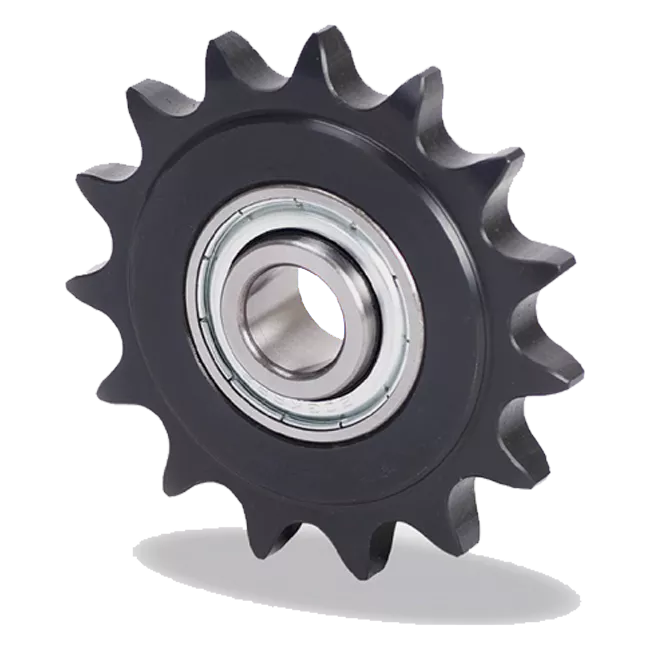
Idler Sprocket With Ball Bearing

Idler Sprocket With Ball Bearing
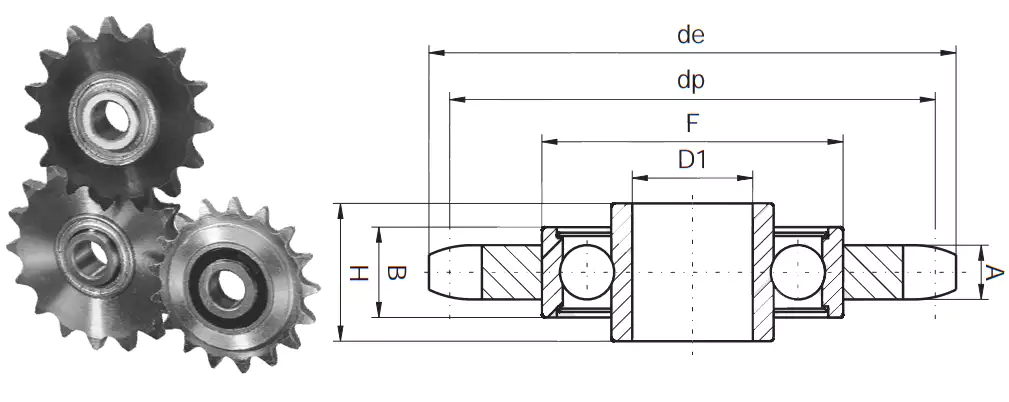
| Z | Pitch | de | dp | A | D1 | F | B | H |
| 23 | 8×3 | 62.15 | 58.75 | 2.8 | 16 | 40 | 12 | 18.3 |
| 21 | 3/8”×7/32” | 68.0 | 63.90 | 5.3 | 16 | 40 | 12 | 18.3 |
| 18 | 1/2”×1/8” | 78.9 | 73.14 | 3 | 16 | 40 | 12 | 18.3 |
| 18 | 1/2”×3/16” | 78.9 | 73.13 | 4.5 | 16 | 40 | 12 | 18.3 |
| 16 | 1/2”×5/16” | 69.5 | 65.10 | 7.2 | 16 | 40 | 12 | 18.3 |
| 18 | 1/2”×5/16” | 77.8 | 73.14 | 7.2 | 16 | 40 | 12 | 18.3 |
| 14 | 5/8”×3/8” | 78.0 | 71.34 | 9.1 | 16 | 40 | 12 | 18.3 |
| 15 | 5/8”×3/8” | 83.0 | 76.36 | 9.1 | 16 | 40 | 12 | 18.3 |
| 17 | 5/8”×3/8” | 93.0 | 86.39 | 9.1 | 16 | 40 | 12 | 18.3 |
| 13 | 3/4”×7/16” | 87.5 | 79.59 | 11.1 | 16 | 40 | 12 | 18.3 |
| 15 | 3/4”×7/16” | 99.8 | 91.63 | 11.1 | 16 | 40 | 12 | 17.3 |
| 12 | 1”×17.02 | 109.0 | 98.14 | 16.2 | 20 | 47 | 14 | 17.7 |
| 13 | 1”1/4×3/4” | 147.8 | 132.65 | 18.5 | 25 | 52 | 15 | 21.0 |
What is Idler Sprocket?
An idler sprocket is a component used in chain drive systems. Its main function is to help guide and support the chain to ensure smooth chain operation. Unlike the drive sprocket, the idler sprocket does not directly drive any load and does not transmit power.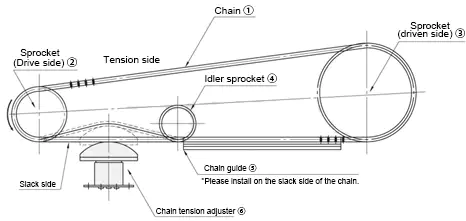
Idler sprockets are usually installed at the non-drive end of mechanical systems, such as conveyor systems, freewheel devices on bicycle rear wheels, and other equipment that requires chain or belt drive. They can be designed with different sizes and tooth shapes according to specific application requirements to accommodate different chain specifications and working conditions. When selecting an idler sprocket, factors such as material strength, corrosion resistance, and wear resistance need to be considered to ensure that it can operate reliably in the expected working environment.
Function of Idler Sprocket
1.Guiding function: Keep the chain in the correct position
- The idler sprocket meshes with the chain through its teeth to ensure that the chain runs along the predetermined path without deviation.
- Function: In the conveying system, the idler sprocket helps guide the chain to prevent it from deviating from the predetermined path or derailing, thereby ensuring the stable operation of the entire system.
- Application scenarios: Suitable for various industrial equipment that require precise path control, such as packaging production lines, assembly lines, etc.
2. Tensioning function: Adjusting the tension of the chain
- The idler sprocket can change the tension of the chain by adjusting its position to ensure that the chain maintains appropriate tension.
- Function: By adjusting the position of the idler sprocket, the length change of the chain caused by wear or thermal expansion and contraction can be compensated, thereby maintaining the optimal working condition of the chain.
- Application scenarios: Widely used in mechanical systems that need to maintain chain tension for a long time, such as conveyors, bicycle chain systems, etc.
3.Support function: Provide additional support in long-distance chain transmission
- During long-distance chain transmission, the idler sprocket can be used as an intermediate support point to prevent the chain from sagging due to gravity.
- Function: By setting multiple idler sprockets in the chain path, it is possible to ensure that the chain maintains a straight or curved path throughout the transmission process, reducing the bending stress of the chain.
- Application scenario: Suitable for applications that require long-distance or large-span chain transmission, such as large material handling systems, factory assembly lines, etc.
4. Direction change: Change the direction of travel of the chain
- The idler sprocket can change the direction of travel of the chain by adjusting its position and angle to meet the needs of complex path layout.
- Function: By reasonably arranging the position of the idler sprocket, the chain can travel along the desired path, whether it is horizontal steering or vertical lifting.
- Application scenario: In situations where the chain path needs to be flexibly changed, such as conveyor systems in multi-storey warehouses, three-dimensional storage equipment, etc.
Components of An Idler Sprocket
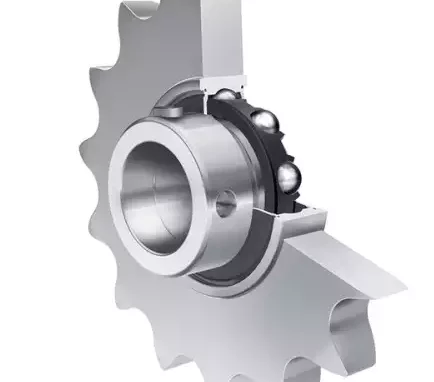
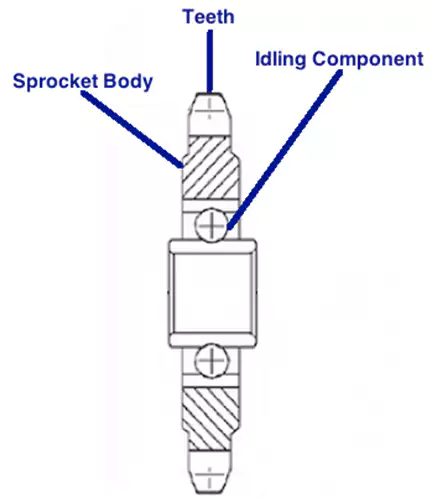
1.Sprocket Body
- The sprocket body is the main structural part of the idler sprocket, usually made of metal materials such as steel, stainless steel or aluminum alloy. It provides a basic platform for installing other components and bears the weight and workload of the entire sprocket. It has a certain thickness and strength to ensure stability and durability under long-term work.
2. Idling Component
- The rotating component refers to the bearing or sleeve in the sprocket body, which allows the sprocket to rotate freely on the shaft. Ensure that the sprocket can rotate smoothly, reduce friction and improve work efficiency. High-quality bearing or sleeve materials are usually used to ensure long-term stable rotation performance.
3. Teeth
- A series of evenly arranged teeth are distributed on the outer edge of the sprocket, which mesh with the links on the chain. The main function of the teeth is to cooperate with the chain, guide the chain to move along the correct path, and maintain the tension of the chain. The number, shape and spacing of the teeth are determined according to the specifications of the chain used to ensure the best meshing effect.
4. Other auxiliary parts
- Bearing Housing: The part that fixes the bearing, ensuring that the bearing can be properly installed and fixed on the sprocket body.
- Seals: Protect the internal bearing from dust and dirt, extending the service life.
- Mounting Screws/Bolts: Screws or bolts used to fix the sprocket to the mechanical equipment.
Showing all 12 resultsSorted by latest
-
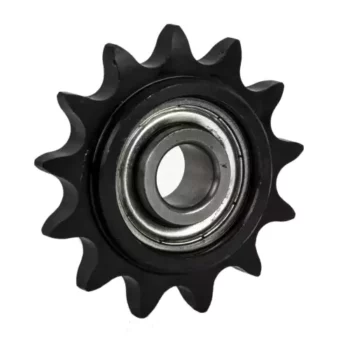
Idler Sprocket 13T 1″1/4*3/4″
-
Idler Sprocket 12T 1″??17.02
-
Idler Sprocket 15T 3/4″??7/16″
-
Idler Sprocket 13T 3/4″??7/16″
-
Idler Sprocket 17T 5/8″??3/8″
-
Idler Sprocket 15T 5/8″??3/8″
-
Idler Sprocket 14T 1/2″??5/16″
-
Idler Sprocket 16T 1/2″??5/16″
-
Idler Sprocket 18T 1/2″??3/16″
-
Idler Sprocket 18T 1/2″??1/8″
-
Idler Sprocket 21T 3/8″??7/32″
-
Idler Sprocket 23T 8??3