
BT-GZXS Planetary Roller Screw
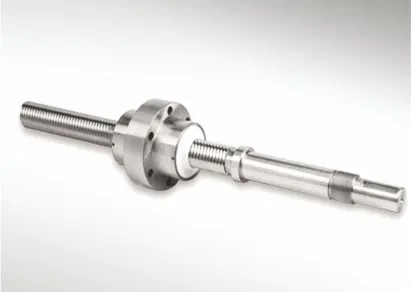
BT-GZXS Planetary Roller Screw
A ball screw is a precision device that converts rotary motion into linear motion with minimal friction. It consists of two parts: threaded shaft and ball bearing. The threaded rod provides a helical raceway for the ball bearing. These ball bearings are like a precision screw that converts a large amount of rotational force into linear motion.
For a ball screw to work correctly, it must have a valid point of contact between the nut and the balls. For example, a gothic arch groove can provide four ball contact points. Pitch diameter is a measure of the distance from the center of the ball bearing to the center of the other side of the screw. This measurement is used to determine the maximum speed of the screw. It is also helpful in resizing.
Ball screws are ideal for a variety of industries and applications. They can perform in extreme environments while remaining refined and durable. Some applications include electric vehicles, where ball screws can replace hydraulic systems used in conventional engines. They are also used in solar panel movement and hydroelectric plant control gate systems. Other applications include motorized inspection tables, steppers, and microscopic integrated circuits.
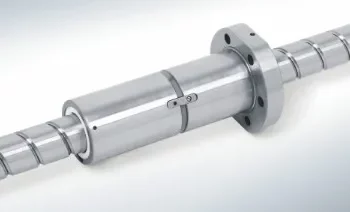
The ball nut is essential in determining the load and life of the ball screw assembly. Ball nuts wear out faster than ball screws, depending on the ratio of ball nut to thread threads. There are two types of ball nuts: internal and external. An internal system returns the ball to the screw shaft. These systems are compact and can be used in small clearance assemblies. In addition to inner and outer ball nuts, end caps and deflectors are also available.


BT-JBSX Planetary Roller Screw has the ability to bear a large load over a long period. Nuts can resist wallop. The adjusting-speed device ensures steady. Significant lead and symmetrical nuts ensure high linearity.
1High load capacity is many contact points to share the load.
2. Long working life
3. Resist wallop
4. Keeping perfect characteristics, no matter any condition
5. Ensure high circulation for the unique design
6. The lead from 4-36mm, no standard lead, cost lower.
7. Linear speed considerable than 100m/min.
8. High efficiency
9. Stable and smooth running
10. Perfect repeatability
11. High reliability
12. Easy estimate working life
13. Low wearing to ensure steady precision.


Accuracy Index of Ball Screw
Another is for transmission()The accuracy degree has 7 degrees; 1 is top, then the following Step down.


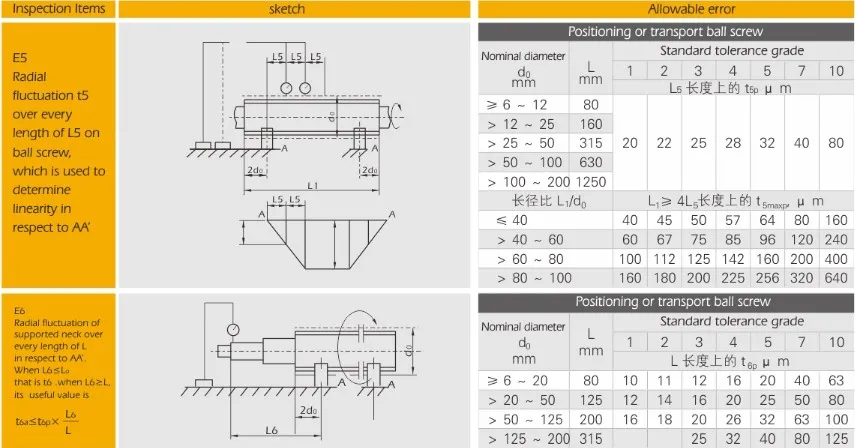

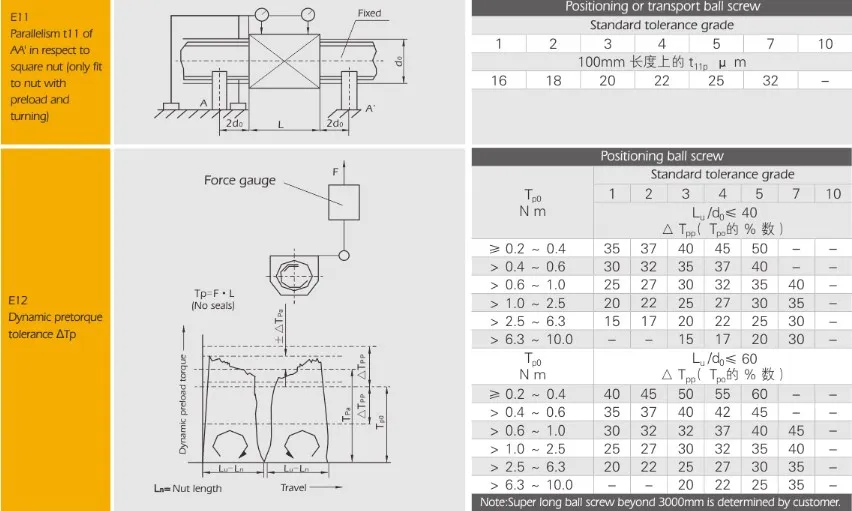
Ball Screw
A ball screw is like a screw that runs on ball bearings. Screws and nuts have matching helical grooves or raceways where ball bearings circulate. There is no physical contact between the screw and the nut. As the screw or nut rotates, the balls reach the trailing end of the nut, where they are deflected or guided from this "pitch" contact by the return tube and return to the leading end of the loop. There, the cycle starts over, and the ball keeps looping.
Big diameter
The outer diameter of the thread.
Small diameter
The diameter of the screw shaft is measured at the bottom of the ball thread track. This diameter is used for column load and critical velocity calculations. Small diameter is also a consideration in support bearing selection.
Ball Section
Circle Diameter The theoretical cylinder that passes through the center of the ball when the ball is in contact with the ball screw and ball nut raceways.
Guide
Travel Axial distance traveled by a screw or nut for one revolution.
Lead error
(Accuracy) The difference between the actual travel distance and the theoretical travel is based on the screw lead. Standard screws will have no lead error of more than +/-.007 inches per foot, and premium screws will not exceed +/-.003 inches per foot. Lead error is accumulated based on the actual length of the ball screw thread. Refer to. Class 7-8 ANSI B5.48-1977. Lead charts describing incremental lead deviation offsets are available (on request). These incremental offsets can be input into the motion controller for lead error compensation.
Match
The lead (synchronized screw) is used when a single driver drives multiple screws to keep the screws in sync. The lead error is matched at the factory to minimize misalignment during the stroke. Consult the factory for more information on matching leads.
Pitch
The distance from one thread on the screw to the corresponding point on the following thread is parallel to the axis of the screw. The pitch is equal to the lead of a single-head screw.
Screw start
The number of individual threads on the screw shaft. The lead of a screw is calculated by dividing the number of threads per inch by the starting number.
Selective fit
The process of selecting a unique ball size to reduce backlash to as low as 0.001 inches.
Material and hardness
Most screws and nuts are alloy steel; case hardened to a minimum of Rc 56. Our stainless steel models are 17-4ph precipitation hardenable stainless steel with a minimum surface hardness of Rc 38. Unique materials are available; please contact the factory.
Screw straight
Degree Screw straightness is critical to reducing screw vibration. Our stock of ball screws goes straight to 0.010 inches per foot and no more than 0.025 inches across the length. We can maintain the straightness of machined screws to 0.002 in/ft (depending on screw diameter and length).
Temperature range
The temperature range of our ball screws is between -65ºF. (-54ºC) and 300ºF. (149ºC) Use a suitable lubricant.
Lubricating
Lubrication is necessary for the optimum life of the ball screw assembly. The calculated life of an unlubricated ball screw can be reduced by up to 90%. In general, standard lubrication practices for anti-friction rolling element bearings apply. Grease, oil, or dry film lubrication can be used. Many ball nuts have a 1/8-27NPT lubrication port machined into the nut body. For models without factory lubrication ports, please contact the factory for advice on lubrication applications.
Ball screw surface
Treatment The ball screw finish is a black oxide coating that helps prevent corrosion during shipping and short-term storage. The anti-rust properties of the screw lubricant enable long-term corrosion resistance. Additional coatings such as nickel, hard chrome, zinc, or other layers can be applied in applications subject to extreme environments.
Features of Ball Screw Pairs
1. High transmission efficiency
In a ball screw assembly, free rolling balls transmit force and motion between the screw and the nut. This transmission method replaces the direct action between the screw and the standard threaded screw pair nut.
Therefore, the sliding friction of the traditional lead screw is replaced by minimal rolling friction so that the transmission efficiency of the ball screw pair reaches more than 90%, and the driving torque of the entire transmission pair is reduced to about 1/3 of the sliding lead screw.
Right, the heat generation rate is thus significantly reduced.
2. High positioning accuracy
The ball screw pair has a low heating rate, a slight temperature rise, and measures such as pre-stretching and pre-tightening the lead screw to eliminate axial clearance during processing so that the lead screw pair has high repeat positioning accuracy.
3. Transmission reversibility
The ball screw pair has no stick-slip friction from the sliding screw, eliminating the possible creeping phenomenon during the transmission process. The ball screw pair can realize two transmission modes—converting rotary motion into linear motion or converting linear motion into rotation. Movement and transmission of power.
4. Long service life
Due to the strict control of the accuracy of the shape of the screw raceway, the surface hardness, and the selection of materials, the actual life of the ball screw pair is much higher than that of the sliding screw.
5. Good synchronization performance
Due to the smooth operation of the ball screw pair, the elimination of axial play, and the consistency of manufacturing, when multiple sets of ball screw pairs are used to drive the same device or numerous identical components, good synchronization can be achieved.
|
Model.Series
|
Style of nut
|
|
G.GD
|
Inner cycle fixed reverser single/double nut style
|
|
CM.CDM
|
Tube single/double nut type
|
|
ZCT
|
Tube big size and extra-load type
|
|
KD
|
Inner cycle high speed type
|
|
Z.ZD
|
Inner cycle rolling single/double nut type
|
|
CBT
|
Tube lead preload type
|
|
JS-FC
|
Tube big lead type
|
|
GWS
|
Micro ball screw
|
|
GZXS
|
Planetary roller Screw
|
|
SG
|
Heavy load type for plastic machinery
|
Ball Screws VS Lead Screws
A ball screw is a mechanical fastener that uses balls that rotate in a nut. It works the same as a lead screw, with some differences. Both are precision devices designed for specific applications. Both are available in a variety of sizes and have different features. Each has advantages and disadvantages, and it is essential to choose the right one for your needs.
The lead of the screw depends on its size, material, and shape. This is an essential consideration for high-speed and precise positioning applications. Lead screws also vary in pitch diameter and the number of threads per unit length, determining how fast they rotate. Depending on the application, lead screws are more expensive and require larger lead diameters than ball screws.
Another essential factor to consider when comparing ball screws and lead screws is the degree of mechanical efficiency. Ball screws are more efficient than lead screws due to their recirculating mechanism. A typical ball screw may be 90% efficient compared to the lead screw's 20% to 25% efficiency. Furthermore, the absence of sliding friction reduces the need for lubrication. These advantages can offset the added initial cost of using a ball screw.
Another difference between a ball screw and a lead screw is their ability to carry different loads. While both lead screws are effective, ball screws are more efficient and can handle heavier loads. Ball screws are generally more rigid than lead screws, allowing higher speeds and load capacities. Plus, they're quieter and vibration-free.
Company Profile
HZPT is a professional manufacturer of mechanical parts. Our main products are helical worm gear reducers, sprockets, taper sleeves, gear and racks, coupling, and other transmission parts. Its products are mainly exported to Germany, Britain, France, and other European countries, with an annual export value of 18 million U.S. dollars, accounting for more than 65% of the total output. The annual output value reached 200 million yuan.
Our products all adopt international, European, and American advanced industrial standards, use precise and good processing equipment, develop reasonable production technology, apply efficient and flexible management systems, and improve the quality management system to ensure that the product quality is good and the price is affordable.
Our factory adheres to the enterprise concept of "quality: the basis of enterprise survival, integrity: the basis of enterprise development, service: the source of enterprise development, low price: the instrument of enterprise development." We are always looking forward to the presence of customers at home and abroad, seeking win-win benefits and joint cause development.


Additional information
| Edited | lyl |
|---|




We promise will offer the best price by the high quality in china! We also accept special order about the products. If you are interested in our products. Please do not hesitate to let us know.We are pleased to give you the detailed information.We promise that our products would be safety and were in high quality and reasonable price. If you are interested in our products, please contact us asap.We are sincerely looking for your cooperation.
Most of our products are exported to Europe or Americas, both standard and nonstandard products available. We can produce as per your drawing or sample. Material can be standard or as per your special request. If you choose us, you choose reliable.
Industries We Service
