
Worm Gears
Worm gears are one of many types of gears available. These types of gears have a shaft driven by a worm that turns in a circular fashion. When this worm rotates, its lead angle becomes too small and it self-locks, preventing reverse motion. They can be used in a variety of applications, including elevators, chain blocks, and fishing reels. The different tooth shapes allow for different applications. As an experienced worm gear supplier, Ever-power provides high-quality China worm gears at the best prices. Check more below and contact us now!
Worm gears and drives are a type of gear arrangement made up of a worm wheel. A worm gear is a type of gear, which has precision meshing is important for the operation of the gear. Worm gears may have teeth that face right or left, and some may have ground teeth. Some worm gear sets are also designed to run in reverse. In such a case, the worm shaft will spin faster than the input, which results in a reverse gear drive. Examples of this type of gear include hand-cranked centrifuges, a blacksmithing forge blower, and the wind governor in a musical box. Worm gear sets are usually assembled in the same housing as the drive.
Worm gears have many advantages over conventional gears. They are able to achieve high reduction ratios with reduced weight. Compared to conventional gears, worm gears have smaller components and lower risks of mechanical failure. Worm gears also need less space, which makes them ideal for small pieces of equipment.
What is the Advantage of a Worm Gear?
A worm gear is a primary mover that has the advantage of being able to transmit torque in either a forward or a backward direction. Its radial positioning makes it possible for higher tolerances than a helical gear.
Worm gears are very common and can be produced in a variety of sizes. Their versatility makes them useful for a variety of machines and devices. For instance, worm gears are used to tune strings on stringed instruments. Their locking mechanism allows them to be locked in at a desired tightness and resistance. A worm gear is especially useful for regulating guitar string tension.
A worm gear can transmit up to 100 kW of power. Worm gears also have a smoother transfer than other types of gears. They can also be used in elevators because the gear can absorb shock loads. Worm gears are also widely used in valve actuators, circular saws, and jacks. They are also sometimes used for precision drives.
A worm gear normally has two shafts that are at right angles. The pitch line of the worm wheel coincides with the outside diameter of the gear. Worm gears can be modified to have additional teeth. Adding teeth can increase the worm’s lead.
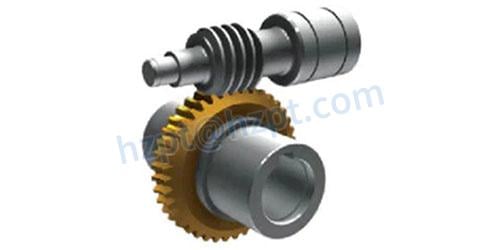
Features of Worm Gears
The circular pitch of a worm gear must match the axial pitch of a larger gear. In other words, the worm gear must have a circular pitch equal to the diameter of its pitch. Worm gears can have left or right-handed threads. In addition, the lead is the distance a particular point on the thread travels per revolution of the worm. This angle is known as the lead angle, and it’s tangent to the helix of the worm’s pitch.
Worm gears can be made in various sizes and configurations. This allows them to be used in a wide range of machines and devices. Worm gears are often used in conjunction with wheel gears to produce low output speed and high torque. The combination of a worm gear and a wheel gear can produce a high-quality, highly efficient gearing.

Material of Worm Gears
Worm gears can be made of bronze, which is a combination of copper and zinc. Bronze can also contain other elements, including tin and nickel. The worm and the gear can be made of dissimilar metals, so their friction coefficients are usually low. Despite these features, the efficiency of worm gears is only 30% to 50%, depending on the reduction ratio.
Lubrication of Worm Gears
To avoid contact with the load, the worm on a worm gear set needs to be well lubricated. This lubricant must be high viscosity and thick enough to prevent the worm from contacting the gear tooth surfaces. Worm gears are often lubricated with special oils.

Applications of Worm Gear and Worm Shaft
Worm gears and shafts are used in various applications due to their unique ability to provide high torque reduction and for their compactness.
- Industrial Machinery: Widely used in large industrial equipment for their ability to handle heavy loads and provide smooth operation.
- Automotive Systems: Employed in steering systems of cars and trucks, where they enable the turning of the steering wheel to translate into precise and smooth movement of the vehicle’s wheels.
- Conveyor Systems: Used in conveyor belts for controlled movement and to manage the speed of the belt in material handling systems.
- Elevators and Lifts: Critical in the lifting mechanisms of elevators and industrial lifts, providing the necessary torque to move heavy weights vertically.
- Robotics: Utilized in robotics for precise control of movements and to handle the stress of repeated actions.
- Gate Operators: Common in automatic gate systems, where they help in the smooth and controlled opening and closing of gates.
- Antennas and Satellite Dishes: Used in the positioning mechanisms of antennas and satellite dishes for precise and smooth adjustment.
- Packaging Machinery: Employed in packaging machines for precise control of the packaging process.
- Wind Turbines: Used in some wind turbine designs for adjusting the angle of the blades and controlling the rotational speed.

Worm Gear Reducer
A top-quality worm gear reducer provides the highest reduction ratios, which allows the multiplication of torque to high levels. Worm drive gearboxes are small and self-locking, which makes them ideal for hoisting applications. This makes them the ideal choice for any situation in which speed control and control of torque are essential. If you’re considering buying a worm-gear speed reducer, be aware you’re probably not going to be the most effective option. But, they do offer distinct advantages.
Gearboxes for the Worm Wheel are efficient in industrial applications where speedy stopping and acceleration are crucial. Worm gears don’t work for back driving, therefore they are ideal for applications which require silence in operation. Worm gears are appropriate for applications that are noisy like lifts and elevators. Worm gears are composed of soft materials that aid in absorbing shocks and prevent failures. They are particularly useful in equipment like rock crushers. They help in preventing unexpected malfunctions.
The worm gear reducer is very durable and requires minimal maintenance. Worm gears are sturdy, and able to withstand the weight of a large vehicle and huge pressure. In the event that you’re using a worm speed reducer, it’s best to select one that provides the highest level of protection and longest service life. They’re also easy to operate.
HZPT is one of the leading worm gear suppliers in China. We provide China worm gears of high quality at competitive prices! Contact us if you are interested!


Worm Gear and Shaft FAQs
What is the primary advantage of using a worm gear and shaft?
The primary advantage of a worm gear and shaft is their ability to provide a high gear reduction ratio in a single stage. This allows for significant torque multiplication and speed reduction in a compact space. They are also known for their smooth and quiet operation.
Can worm gears provide reverse motion?
Generally, worm gears are self-locking, meaning they cannot be driven backwards by the load. This happens when the lead angle is small, making it impossible for the load to drive the worm. However, with a larger lead angle, reverse motion is possible, but at the cost of reduced load-carrying capacity and efficiency.
What materials are commonly used for worm gears and shafts?
Worm gears and shafts are typically made from materials such as bronze, brass, or hardened steel. The worm is often made of a harder material than the gear to ensure a longer lifespan since the gear undergoes more wear.
How does the efficiency of a worm gear compare to other gear types?
Worm gears tend to be less efficient than other gear types like spur or helical gears, mainly due to the sliding contact between the gear teeth which leads to friction and heat. Efficiencies can range from 40% to 90%, depending on the design and lubrication.
What are the maintenance requirements for worm gears and shafts?
Maintenance typically involves regular lubrication to minimize friction and wear, as well as periodic inspections to check for wear and alignment issues. The choice of lubricant is crucial and depends on the material and operating conditions of the gear. Proper alignment of the worm and gear is also important for optimal performance and longevity.


Last Update Knowledge & News
No Results Found
The page you requested could not be found. Try refining your search, or use the navigation above to locate the post.
Related Product Introductions
No Results Found
The page you requested could not be found. Try refining your search, or use the navigation above to locate the post.