
Horizontal Auger Bearing Seat

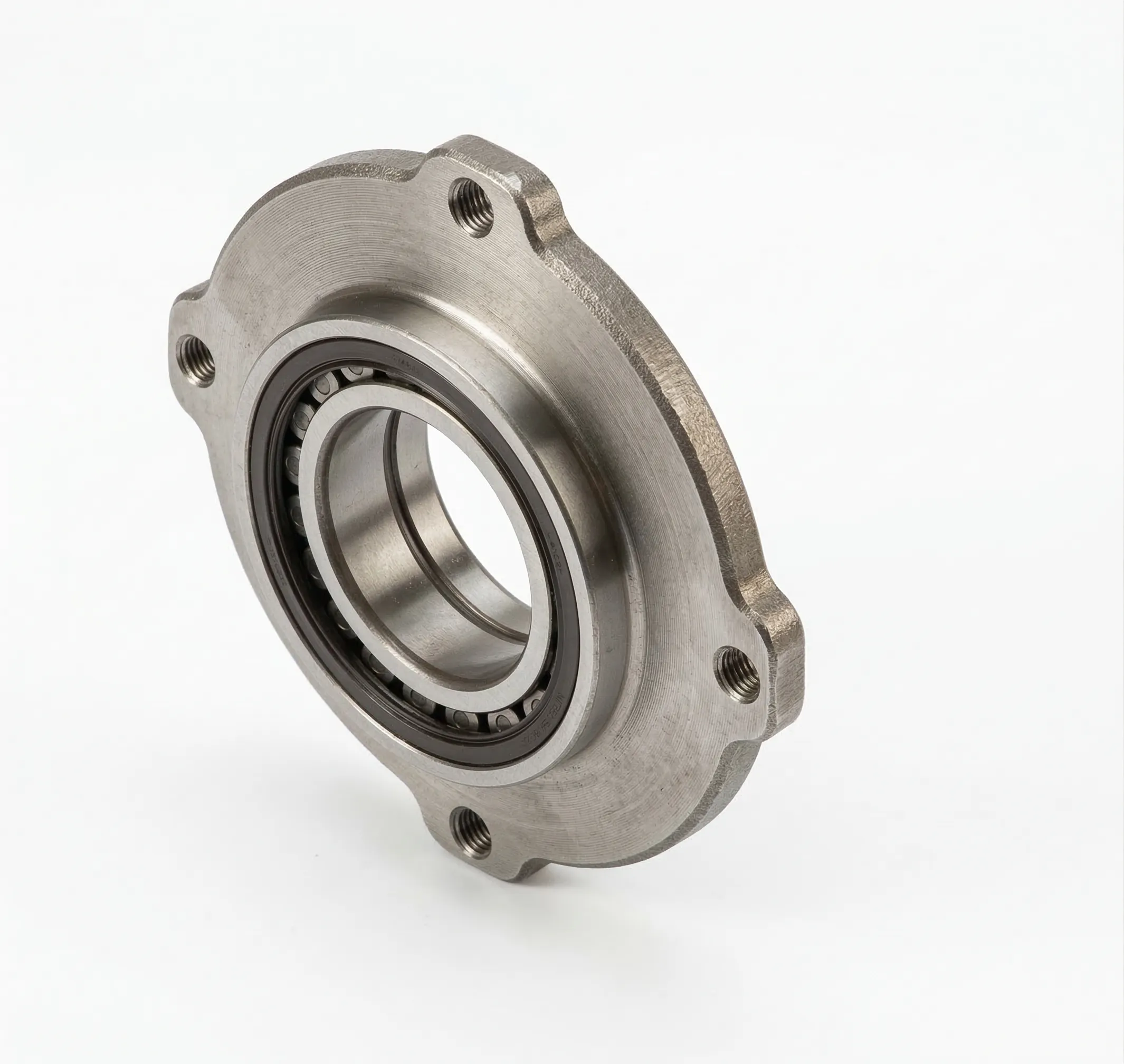
The EVER-POWER Horizontal Auger Bearing Seat (158×35 mm) is precision-engineered from QT450-10 ductile cast iron for superior shock resistance and fatigue life under heavy auger loads. Its post-normalization H7-bored Ø35 mm bore ensures concentric alignment, while the dual-layer electrophoretic primer and epoxy powder coating delivers verified 480-hour salt-spray protection. Direct-fit compatibility and full traceability yield 3–5 seasons of reliable service in demanding grain and paddy environments.
Section 01
Product Specifications
The Horizontal Auger Bearing Seat (158×35 mm) is a core header component in the grain conveyance system of combine harvesters and rotary tiller header assemblies. It houses the bearing that supports the horizontal auger shaft — the rotating element responsible for moving cut grain laterally toward the feeder house. Without an accurately bored, structurally sound bearing seat, the auger shaft deflects under load, grain throughput falls, and bearing life collapses. The following table presents the actual dimensional and material specifications of this part.
Section 02
Engineering Overview & Standout Features
The horizontal auger is the invisible workhorse of any cutting platform. It runs the full width of the header at high RPM, shifting thousands of kilograms of crop material every hour. The bearing seat is what keeps that shaft in place — and when it fails, the auger drops, the crop flow stops, and the machine goes down in the field at the worst possible moment. EVER-POWER's 158×35 mm Horizontal Auger Bearing Seat was developed with a specific engineering mandate: hold the shaft in alignment under the full spectrum of conditions a working combine actually faces, not just the conditions a catalogue test-bench simulates.
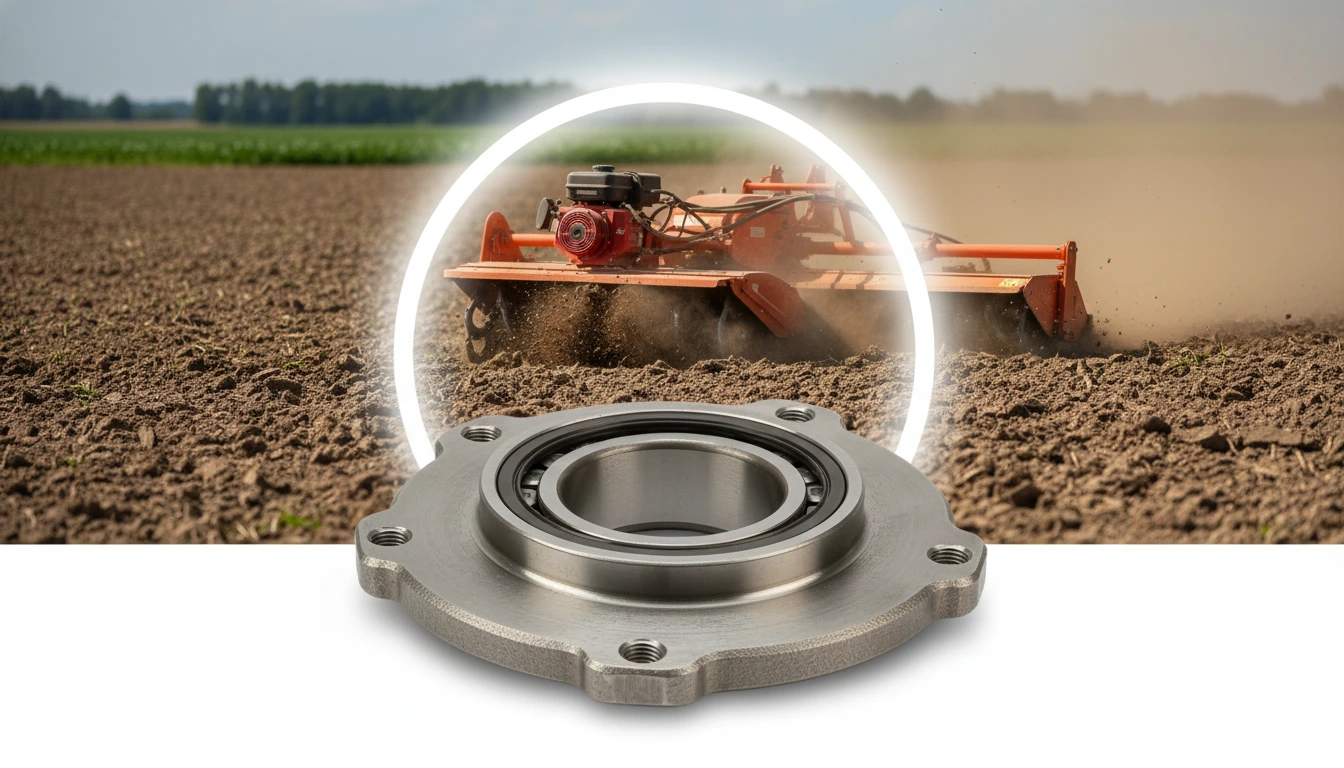
Post-Cast Precision Boring
The Ø35 mm H7 bore is CNC-finish-machined after full normalizing heat treatment — meaning the bore geometry is established in the final, dimensionally stable state of the iron, not in the as-cast state that subsequently changes. This eliminates the systematic bore-ovality errors that produce eccentric bearing loading and premature failure in competing products machined before heat treatment.
480-Hour Corrosion Rating
A two-stage surface system — cathodic electrophoretic primer baked at 180 °C followed by a 60–80 μm epoxy powder topcoat — delivers verified 480-hour salt-spray performance per ISO 9227. In the wet, muddy, acidic environment of paddy-field harvesting, this is not a marginal improvement; it is the difference between a seat lasting two seasons or two harvests.
Shock-Resistant Ductile Iron
QT450-10 ductile iron absorbs impact energy through its nodular graphite microstructure rather than fracturing like grey iron. When a combine's auger strikes a stone or bale wire buried in the crop flow — an event that happens several times per season in real field conditions — the seat flexes slightly rather than cracking at the bolt bosses, which is the characteristic failure mode of HT200 grey iron alternatives.
Drop-In Header Compatibility
The 120 mm two-bolt mounting pattern matches the standard header frame pitch used across the dominant combine harvester platforms sold in Asia and Europe. No modification of the header frame is required for the most common applications — a critical feature for machinery dealers who service multiple brands and need a single reliable replacement part in stock rather than brand-specific variants.
Full Batch Traceability
Every unit leaves the factory with a barcoded batch certificate linking it to the spectral analysis of the melt, the CMM bore measurement record, and the coating batch salt-spray report. For OEM assemblers or procurement teams who must maintain quality records for warranty or insurance purposes, this documentation chain is available in full on request without additional lead time.
All-Climate Rated
The −25 °C to +85 °C operating window covers every major grain-producing climate zone, from early spring barley harvesting in northern China and Kazakhstan to high-summer paddy seasons in the Mekong Delta or the Gangetic Plain. The ductile iron grade maintains its toughness through the full range without the cold-morning brittleness that affects lower-specification grey iron seats in sub-zero field starts.
Section 03
Materials & Manufacturing Process
Material choice for a bearing seat is not simply a question of strength. The seat must resist fatigue under cyclic rotational loads, tolerate abrasive grain dust that infiltrates even sealed bearings over time, and hold its bore diameter through decades of thermal cycling between cold field mornings and hot afternoon harvesting. QT450-10 ductile iron was selected after comparative testing against grey iron (HT200, HT250) and steel fabrications — ductile iron delivered the best combination of machinability, shock resistance, and corrosion response at production scale.
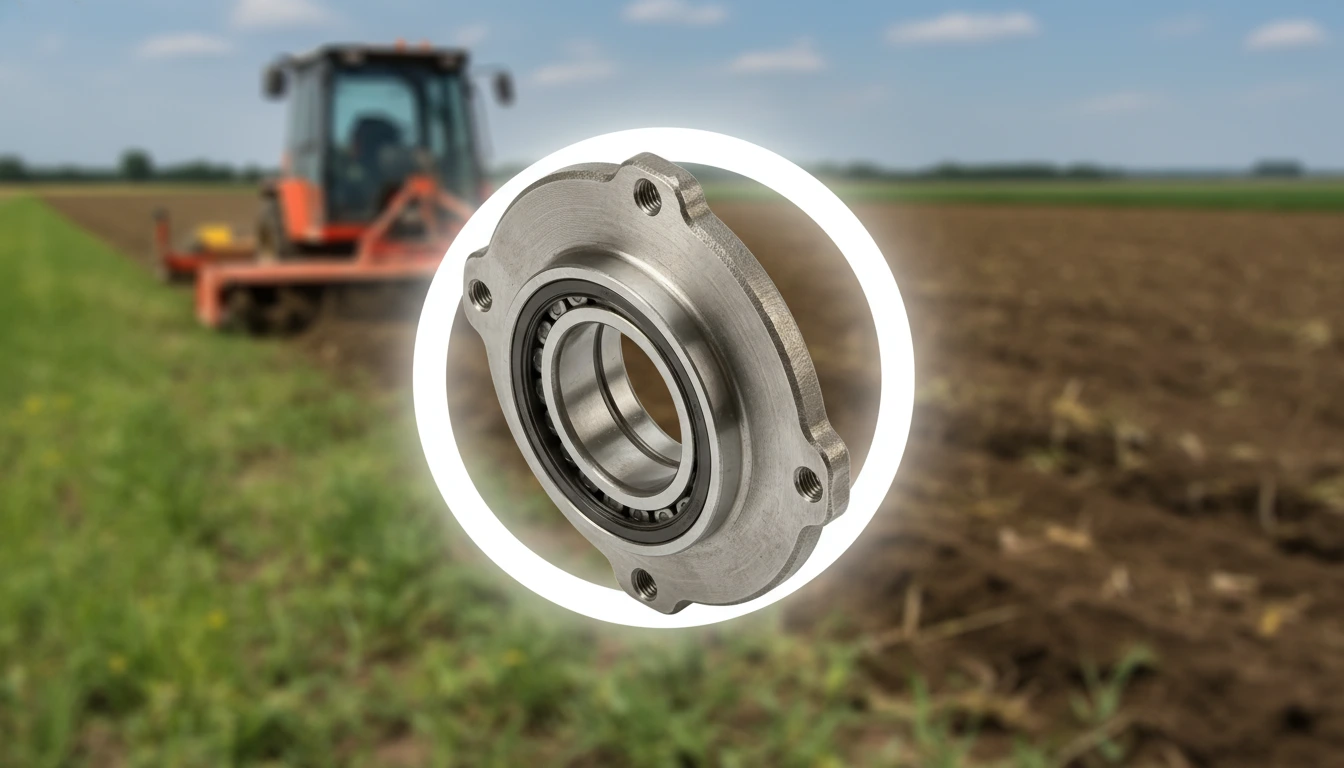
Six-Stage Production Sequence
🏭
Melt Composition Verification
Each production heat is spectrometrically checked against GB/T 1348 before casting begins. Carbon equivalent, silicon content, and magnesium residual are logged to ensure adequate nodularization. A heat that falls outside specification is rejected before the metal enters the mold — not after machining, which is how many lower-cost suppliers discover problems.
🔥
Resin-Sand Casting
Resin-bonded sand molds provide surface accuracy and internal cavity definition superior to green-sand processes. Pour temperature is maintained at 1,355–1,385 °C. Controlled in-mold cooling for 50–65 minutes prevents thermal shock stresses that would otherwise manifest as micro-cracking in the thin-wall sections of the bearing housing flange.
⚙️
Normalizing Heat Treatment
Castings are normalized at 860–920 °C for 80–100 minutes in a continuous atmosphere furnace, then air-cooled at controlled rate. This step converts the microstructure to a uniform pearlitic matrix, relieves residual casting stress, and raises the hardness to the 160–210 HB target. It is the single manufacturing step most commonly skipped by budget suppliers — its absence costs buyers 20–30% of service life.
🖥️
CNC Bore Machining & CMM Verification
The bearing bore, mounting face, and bolt holes are all machined in a single CNC clamping to eliminate inter-surface squareness errors. The Ø35 mm H7 bore is finished to Ra 1.6 μm. Every 50-piece batch undergoes CMM verification of bore diameter, bore cylindricity, mounting face flatness, and bolt-hole position — a documented record accompanies each shipment on request.
🎨
Dual-Layer Corrosion Coating
Sa 2.5 shot-blast → cathodic e-coat primer (20–25 μm, baked 180 °C) → epoxy powder topcoat (60–80 μm). The primer penetrates micro-porosity in the iron surface that a powder-only system cannot reach, providing a continuous corrosion barrier that survives field impact chipping far better than single-coat alternatives used by lower-tier suppliers.
✅
Final Inspection & Export Packaging
Visual inspection, bore plug installation, VCI anti-rust film wrapping, individual foam-padded carton, barcode label with batch code and specification data. Pallets are heat-treated per ISPM 15 for unrestricted phytosanitary clearance across all export markets. A full inspection certificate is generated per batch and available electronically within 24 hours of shipment.
Section 04
Related Components & Accessories
The Horizontal Auger Bearing Seat is one node in a chain of interdependent rotary tiller parts. When sourcing a replacement, the condition of every connected component should be assessed — otherwise the new seat simply inherits the damage pattern of the worn system it enters. The following parts are the most commonly co-replaced or co-inspected items:
🔗
Horizontal Auger Shaft
The Ø35 mm shaft running through this seat must be checked for straightness (max 0.08 mm TIR over its full length) and surface wear at the bearing journal. A worn journal will destroy a new bearing regardless of seat quality — measure before installing the replacement seat.
⚙️
Deep-Groove Ball Bearing 6207 / 6307
The primary wear item housed in this seat. Specify C3 clearance class and 2RS (rubber-sealed) variant for field use. Replace bearing and seat simultaneously whenever bore radial play exceeds 0.12 mm — bearing-alone replacement into a worn bore provides only temporary relief.
🌀
Auger Flighting (Spiral Blade)
Worn or damaged auger flighting creates uneven thrust loading on the shaft, which transfers to the bearing and seat as asymmetric radial force. Inspect the full length of flighting whenever a bearing seat is replaced — uneven wear on the flighting is a reliable leading indicator of future seat problems.
🔩
Header Side-Sheet Mounting Bracket
The structural bracket welded to the header side-sheet that the bearing seat bolts to. Inspect for cracking at the weld toes and for flatness at the seat mating face — a distorted bracket introduces bending moment into the seat even when the seat itself is perfectly installed.
🛢️
Grease Nipple (Zerк / DIN 71412)
Some seat variants incorporate a grease nipple port for open-bearing configurations. Always replace the nipple when replacing the seat — old nipples with partially blocked check balls give a false sense of lubrication while delivering nothing to the bearing raceway.
🔐
Shaft Lock Collar / Circlip
The axial retention device that prevents the shaft from walking out of the bearing during operation. A worn or missing collar causes the shaft to drift laterally, loading the bearing outer ring against the seat lip and accelerating bore wear — replace with the bearing and seat as a set.
📐
Auger Drive Chain / Belt Assembly
An over-tensioned drive chain applies a persistent side-load to the auger shaft that the bearing seat must continuously resist. Check chain tension (target: 10–15 mm free play at mid-span) whenever the seat is replaced — excess tension is a frequent root cause of accelerated bearing seat wear.
🧲
Dust / Crop Seal
Some header designs incorporate a felt or rubber seal at the inboard face of the bearing seat to prevent chaff and grain dust ingestion. Replace this seal simultaneously with the bearing — a worn seal allows fine abrasive dust to bypass even a sealed bearing's contact lip seals over time.
Related Products
Explore EVER-POWER's Full Rotavator & Rotary Tiller Range
PTO shafts, header gearboxes, cutting blades, reel brackets & complete header assemblies
Section 05
Compatibility & Cross-Reference
The 158×35 mm standard fits the horizontal auger shaft end-housing position across a wide range of header types. The table below covers the platform families for which EVER-POWER has verified direct fitment. For machines not listed, contact the technical team with your header drawing or the old seat dimensions — custom bore and bolt-pattern variants are available in 15–25 days from drawing approval.
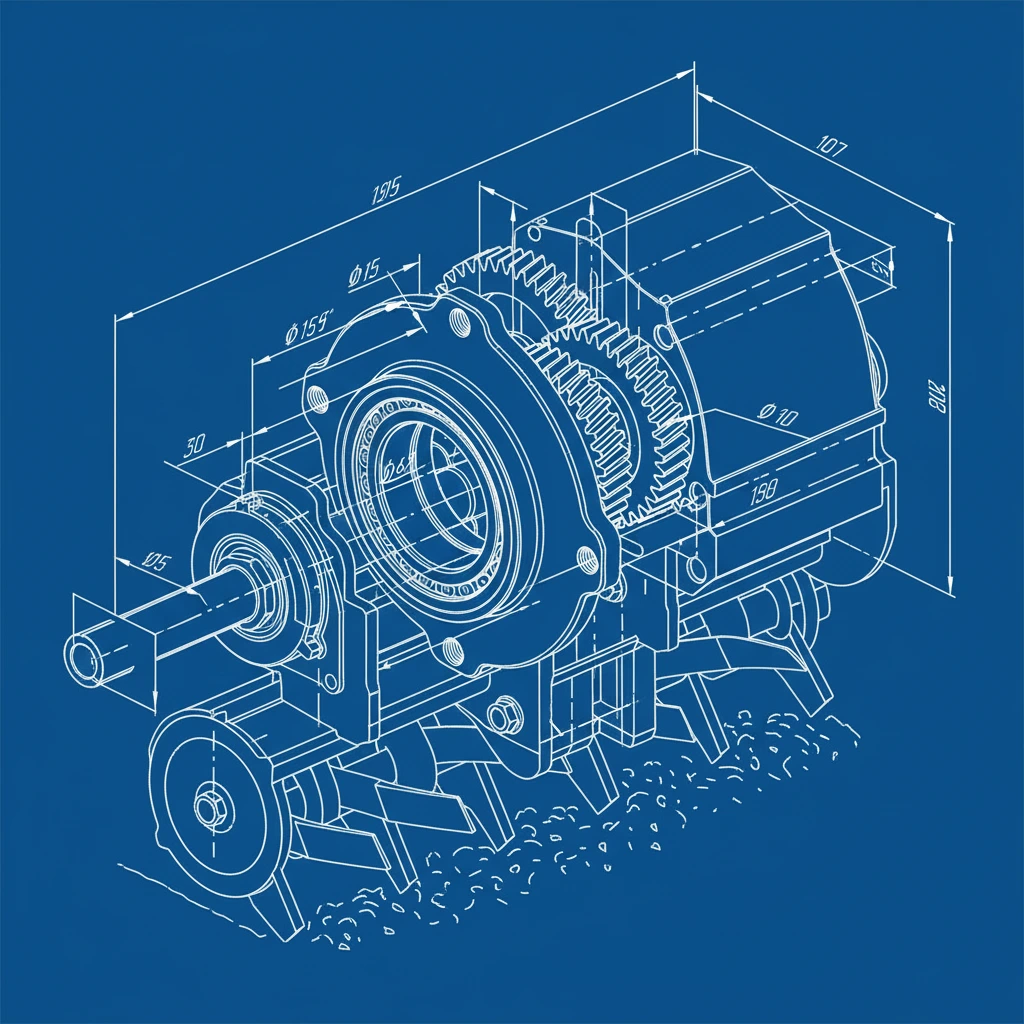
Alternate bore diameters (Ø30 mm, Ø40 mm, Ø45 mm) and custom bolt patterns available. Send machine model and head drawing to [email protected].
Section 06
Replacement Guide
A bearing seat replacement on a header auger is a straightforward 60–90 minute job with standard tools, but the sequence matters. Two of the most common post-replacement failures — premature bearing seizure and recurrence of bore wear — both trace back to steps done out of order: bearing pressed in before the seat is fully torqued, or shaft reinstalled without checking journal diameter. The procedure below eliminates both failure paths.
Machine Isolation
Park on level ground, lower the header to the ground, disconnect the battery. Engage the header lock pin if fitted. Tag out the PTO lever — auger shafts can rotate through residual hydraulic pressure even with the engine off on some models.
Auger Drive Disconnect
Remove the drive chain or belt from the auger sprocket/pulley. On chain drives, split the chain at the masterlink; on belt drives, slacken the tensioner. Do not remove the sprocket from the shaft until the bearing seat bolts are already loose — the sprocket acts as the reaction point for bolt-loosening torque.
Seat & Shaft Removal
Remove the two M10 mounting bolts — apply penetrating oil if corroded and wait 15 minutes. Support the auger shaft with a floor jack under the centre before withdrawing the seat, to avoid shaft drop damaging the auger trough. Slide the shaft carefully out of the old seat bore.
Shaft Journal Inspection
Measure shaft diameter at the bearing journal with a micrometer. Nominal is 35 mm; reject if worn below 34.94 mm or if out-of-round exceeds 0.04 mm. A worn journal is the most common reason a replacement bearing fails within one season — install a new shaft segment if measurements are out of tolerance.
Bearing Installation
Chill the new 6207/6307 bearing in a freezer bag for 25 minutes. Warm the new seat bore with a heat gun to 80–100 °C. Press bearing squarely into the bore — tool must contact the outer race only. Verify flush seating with a depth gauge. Allow to return to ambient temperature (about 20 minutes) before mounting.
Mount, Torque & Verify
Mount the seat to the bracket. Apply copper anti-seize to M10 thread; torque to 48–52 N·m in two diagonal passes. Slide the shaft through the bearing — it should pass freely by hand with no binding. Reinstall the drive and check chain tension at 10–15 mm free play. Run the machine at low PTO for 5 minutes, then re-torque the mounting bolts while warm.
Section 07
Applications Across Industries & Machinery
The horizontal auger bearing seat's core function — supporting a rotating shaft that conveys bulk material laterally — appears in more machinery categories than most buyers initially assume. While grain harvesting is the dominant use case, the structural and dimensional specification of the 158×35 mm seat makes it a viable and validated component in several adjacent agricultural and processing applications.
Grain Combine Headers
The primary application: the horizontal auger on combine harvester cutting platforms, running the full width of the header, moves freshly cut grain from the outer wings to the feeder house throat. Bearing seats at both ends of the auger shaft must maintain precise alignment through harvest days exceeding 16 hours at high throughput. Across Asia and Eastern Europe, where grain harvests are compressed into short weather windows, in-season seat failure causes disproportionate economic damage.
Paddy Rice Harvesting
Half-feed rice harvesters in Vietnam, Bangladesh, and Indonesia subject the auger bearing seat to the most aggressive corrosion environment in agricultural machinery: saturated mud, rice straw acid, high humidity, and frequent daily washdowns. The dual-layer coating of EVER-POWER's seat was specifically validated for paddy-field salt-spray equivalence. Customers in this segment report 2–3× longer seat life compared to single-coat alternatives purchased from local markets.
Tractor-Mounted Headers
In India, Pakistan, and Sub-Saharan Africa, tractor-mounted cutting headers are assembled by regional OEMs as a cost-effective alternative to self-propelled combines. These manufacturers source individual header components including the auger bearing seat, and consistently list dimensional consistency across batches as their top procurement priority — a requirement EVER-POWER meets through per-batch CMM verification with traceable records.
Specialty Crop Harvesters
Sunflower, rapeseed, and soybean harvesters operate their auger systems under higher-than-grain thrust loads because the crop material is bulkier per unit weight. The QT450-10 ductile iron construction of this seat handles the elevated radial forces from these denser crop flows without the cracking at bolt-boss sections that limits the service life of grey iron alternatives in specialty-crop applications.
Grain Handling Equipment
Fixed grain-handling installations — pit augers, bucket elevator intakes, horizontal transfer conveyors in grain stores and feed mills — frequently use the same shaft diameter and bearing specification as combine headers. Buyers in the grain storage and feed-processing industry have sourced this seat as a field-proven alternative to fabricated pillow-block housings, at lower cost and with faster delivery than custom-machined options.
Rotary Tiller Side-Discharge
Some rotary tiller header designs incorporate a short horizontal auger to clear tilled soil from the operating zone before the next pass. These systems run at lower RPM but under high side-load from compacted soil material. The 158×35 mm seat functions without modification in these applications and is stocked by several rotary tiller accessory distributors across South and Southeast Asia as a universal replacement for the auger end-housing position.
Section 08
Maintenance & Service Schedule
The single biggest driver of premature auger bearing seat failure is not poor-quality parts — it is deferred maintenance on the bearing and associated components. A bearing that is running warm, dry, or out of balance applies amplified loads to the seat that were not factored into its design life. The schedule below is based on 250–350 annual operating hours in mixed grain crops; reduce all intervals by 25% for continuous paddy or high-throughput maize harvesting.
Daily — Pre-Shift
- Visual check: new paint chips, fresh rust weeping, or visible cracks at bolt bosses
- Listen for bearing noise (grinding, rumbling) during first 3 minutes at idle PTO speed
- Check mounting bolts for looseness by attempting rotation by hand at the bolt head
- Confirm drive chain/belt tension at 10–15 mm free play before engagement
50-Hour Service
- Torque-check M10 mounting bolts: 48–52 N·m (anti-seize thread)
- Grease via nipple if open-bearing configuration: 3–4 g NLGI 2 lithium-complex
- Check radial play at shaft end: replace bearing if play exceeds 0.12 mm
- Inspect coating at impact points; apply cold-zinc primer to bare iron spots
End-of-Season Storage
- Pressure-wash and dry completely before storage — trapped mud accelerates corrosion
- Apply VCI corrosion-inhibitor wax to all unpainted surfaces
- Measure and record bore diameter — compare against previous season for wear trend
- Pre-emptively replace bearing if over 280 hours since last replacement
Warning Signs Requiring Immediate Shutdown
Section 09
Market Price Benchmarking
Price ranges for the 158×35 mm horizontal auger bearing seat vary by a factor of five across the market. The variation is not arbitrary — it maps almost perfectly to the manufacturing specification gap described in this article. Understanding where a quoted price sits in this landscape is the first step to evaluating whether a low-priced offer represents genuine value or deferred failure cost.
Prices are indicative FOB Hangzhou, 2024–2025. Volume discounts at 50 and 200-unit thresholds. Contact [email protected] for a firm quote with current freight cost to your port.
Section 10
EVER-POWER vs. Market Alternatives
Every supplier's catalogue photo shows a black bearing seat of roughly the same dimensions. What catalogue photos cannot show is whether the bore was machined after heat treatment, whether the coating system has been salt-spray tested, or whether there is a quality record behind each batch. This table places the critical technical differentiators side by side.
Section 11
Sustainability & Regulatory Compliance by Region
Agricultural machinery import compliance is increasingly stringent across EVER-POWER's key markets, and buyers who source without verifying documentation chains risk customs holds, duty reclassification, or blocked warranty programs. The following summaries reflect the compliance posture relevant to each major buying region for this product.
India
India's largest market for this product category by volume. Parts are manufactured to IS 1865 (ductile iron) equivalent, supporting BIS import classification. Recycled scrap content (~40% of melt) aligns with India's green-procurement criteria being rolled out under PMFBY-linked subsidy programs for mechanized farming equipment in multiple states.
Vietnam & ASEAN
Exported under ACFTA Form E certificates (0–5% duty versus standard rate). The e-coat primer uses water-based chemistry free of restricted azo dyes and heavy metals regulated under Vietnam Circular 21/2017/TT-BCT and ASEAN chemical safety frameworks. Mekong Delta paddy cooperatives represent a significant and growing share of annual order volume.
Bangladesh & Pakistan
Mill certificates, packing lists, and ISO 9001:2015 certification copies accompany each shipment, satisfying NBR (Bangladesh) and FBR (Pakistan) customs valuation requirements for the agricultural machinery spare-parts tariff category. ISPM 15 heat-treated pallets clear phytosanitary inspection at Chittagong and Karachi without additional treatment certificates.
Brazil & South America
Full INMETRO product documentation and NCM tariff code classification provided with each order. Brazil's rapidly growing combine harvester aftermarket — driven by Mato Grosso and Paraná soybean expansion — is a significant growth market. MAPA phytosanitary requirements for ISPM 15 packaging are met as standard on all export pallets.
Sub-Saharan Africa
Growing mechanization programs in Ethiopia, Kenya, Tanzania, and Nigeria, often funded through FAO or bilateral aid frameworks, require third-party test reports alongside supplier certifications. EVER-POWER's ISO 9001 accreditation and available salt-spray and tensile test reports satisfy the technical documentation requirements of these institutional procurement processes.
Environmental Footprint
Approximately 40% of each melt heat consists of reclaimed agricultural and industrial cast-iron scrap, reducing primary ore extraction. The water-based electrophoretic primer eliminates VOC emissions during the primer stage. Waste paint-bath fluid is managed under China's GB18597 hazardous-waste regulation — full disposal records are available on request for buyers requiring environmental due-diligence documentation.
Section 12
Customer Reviews
"We manage 14 half-feed rice harvesters across three cooperatives in the Mekong Delta. Before switching to these bearing seats, we were replacing them every wet season without fail — the grey iron ones simply couldn't handle the paddy mud and moisture. Now we're into our third season with the original EVER-POWER seats still in service. The coating is genuinely holding, even where mud buildup was worst."
"I assemble tractor-mounted wheat headers for the Punjab market and source roughly 200 bearing seats per season. The bore-to-bore consistency across batches from EVER-POWER is what keeps me coming back — I can line-assemble without individual bore checking, which saves significant time. Two other suppliers I tried required 100% bore inspection on receipt because of dimensional scatter. That hidden cost disappears with this supplier."
"We import agricultural machinery components for the Ethiopian market and have been stocking these seats for two seasons. The documentation package — mill cert, test report, ISO certificate — is exactly what our institutional customers need when tendering for government-linked mechanization programs. The one area I'd like to see improved is faster sample lead time; the 5-day express sample took 9 days on our first order, though subsequent orders have shipped well within the quoted window."
"Running a combine repair workshop in West Bengal means I stock everything that fails during harvest. The auger bearing seat fails more often than most people realize — not because it's a weak component, but because it's overlooked until the bearing seizes. Since stocking EVER-POWER's version, I've had zero comebacks on warranty. The bore is right, the iron takes the shock without cracking, and the coating survives the post-harvest pressure wash without lifting. Exactly what I need to keep customers coming back."
Section 13
Customer Case Studies
Case Study 01 — India
Workshop Parts Cost Reduction, Punjab
A combine service centre in Amritsar was replacing auger bearing seats every harvest season across a fleet of 22 customer-owned machines — an annual outlay of approximately $132 at market grey-iron pricing. After switching to EVER-POWER's ductile iron seats, the replacement cycle stretched to once every 2.5 seasons on average. Three-year bearing seat expenditure dropped from $396 to $187, while customer complaints about repeated bearing noise disappeared from the service log entirely.
Case Study 02 — Vietnam
Bearing Failure Rate Reduction, Mekong Delta
A rice harvesting cooperative in Tien Giang Province was experiencing 2.2 auger bearing replacements per machine per growing season. Investigation confirmed bore ovality in the locally sourced grey-iron seats was the root cause — eccentric loading destroyed the bearing raceways within 80–100 operating hours. After installing EVER-POWER seats with H7-verified bores and sealed 6207 bearings, the bearing replacement rate dropped to 0.4 per machine per season over two consecutive seasons, reducing bearing expenditure by 82%.
Case Study 03 — Pakistan
OEM Warranty Claim Elimination, Lahore
A Lahore-based header manufacturer assembling approximately 180 units annually under their own brand was receiving a steady stream of dealer warranty claims for premature auger bearing failure — traced to single-coat corrosion on locally sourced seats failing within the first monsoon season. Switching to EVER-POWER's dual-coat seats eliminated the corrosion-driven failure mode. Warranty claims for this specific issue dropped from an average of 34 per season to zero in the two seasons following the switch, saving an estimated $4,100 in warranty parts and service labour annually.
Frequently Asked Questions
Technical and procurement guidance for the auger bearing seat (158×35 mm). For drawing pre-checks or engineering queries, contact [email protected].



We promise will offer the best price by the high quality in china! We also accept special order about the products. If you are interested in our products. Please do not hesitate to let us know.We are pleased to give you the detailed information.We promise that our products would be safety and were in high quality and reasonable price. If you are interested in our products, please contact us asap.We are sincerely looking for your cooperation.
Most of our products are exported to Europe or Americas, both standard and nonstandard products available. We can produce as per your drawing or sample. Material can be standard or as per your special request. If you choose us, you choose reliable.
Industries We Service
