
Weld On Sprocket & Hub
Weld on sprocket and hub is a sprocket and hub combination that is welded to the shaft and is used to transmit power and drive the chain. Our high-quality welded sprockets and hubs: durable, reliable and efficient
Weld On Hub Sprockets Sizes Available
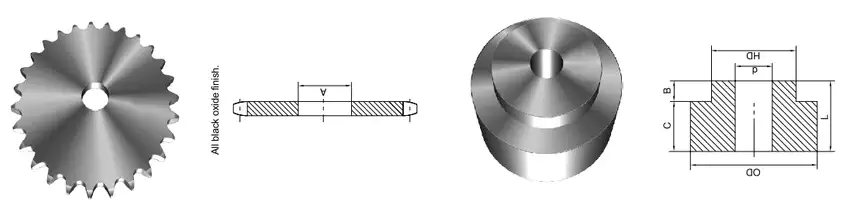
When is Weld on Sprocket and Hub Necessary?

When existing standard sprockets cannot match a specific shaft diameter, welded sprockets and hubs allow users to select the appropriate hub for welding according to the actual shaft diameter, providing greater flexibility.
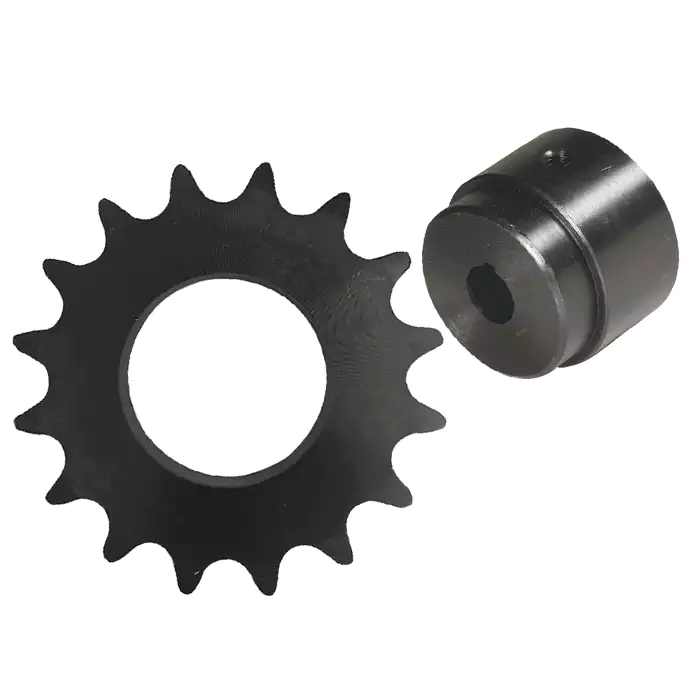
Hub For Weld on Sprocket
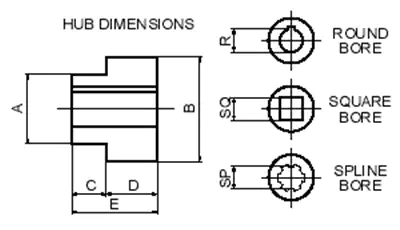
Pick a plate sproket and a finished bore hub you need.By welding,you make a B type finished bore sprocket quick and easy in emergency use.It’s economy and save youe time. A few stock of plate sprocket and hub can serve you a variety of sprocket sizes.Unique and convenience in your repair and replacement need.
We recommend to use Low Hydrogen Electrodes for welding sprocket parts.
| Hub No. | V | W | X | XX | Y |
| A | 1-1/8 | 1-5/8 | 2 | 2 | 2-3/4 |
Features of Weld-on Hub Sprocket
Non-standard shaft diameter
- When the existing standard sprocket cannot match the specific shaft diameter, the welded sprocket and hub allow users to select the appropriate hub for welding according to the actual shaft diameter, providing greater flexibility.
Special Design Requirements
- In applications where special designs or dimensions are required, welded sprockets and hubs can be custom made to meet specific needs, such as special tooth shapes, bore diameters or other geometric features.
High-load applications
- In heavy machinery and industrial equipment, welded sprockets and hubs can provide higher load capacity and more stable transmission performance, ensuring reliable operation of equipment under high loads
Harsh environments
- In harsh working environments such as corrosive, hot or humid environments, the service life of welded sprockets and hubs can be extended by selecting corrosion-resistant materials (such as stainless steel).
Frequent Replacement:
- In certain applications where frequent replacement of sprockets or hubs is required, a welded design can provide a more secure connection and reduce failures due to loosening or wear.
Space Constraints
- In space-constrained or compact applications, welded sprockets and hubs can be custom-made to fit specific space requirements.
Showing 1–12 of 226 resultsSorted by latest
-
100Y36 Weld-on Sprocket with Hub
-
100Y35 Weld-on Sprocket with Hub
-
100Y32 Weld-on Sprocket with Hub
-
100Y30 Weld-on Sprocket with Hub
-
100Y28 Weld-on Sprocket with Hub
-
100Y26 Weld-on Sprocket with Hub
-
100Y25 Weld-on Sprocket with Hub
-
100Y24 Weld-on Sprocket with Hub
-
100Y23 Weld-on Sprocket with Hub
-
100Y22 Weld-on Sprocket with Hub
-
100Y21 Weld-on Sprocket with Hub
-
100Y20 Weld-on Sprocket with Hub
How to Choose the Right Sprocket and Hub
1. Determine application requirements
- Load: Determine the load requirements of the drive system, including torque and power.
- Speed: Understand the operating speed (RPM) of the sprocket.
- Environment: Consider the operating environment, such as temperature, humidity, corrosive substances, etc.
- Space constraints: Measure the installation space and ensure that the sprocket and hub can accommodate.
2. Choose the right sprocket type
- Standard sprocket: Suitable for most general applications.
- Weld On Hub Sprocket: Suitable for applications that require high load capacity and customized shaft diameters.
- QD Bushing Sprocket: Suitable for applications that require quick replacement or adjustment.
- Double or multi-row sprocket: Suitable for applications that require higher strength and stability.
3. Determine sprocket specifications
- Number of teeth: Select the appropriate number of teeth based on the transmission ratio and chain length.
- Pitch: Select the sprocket pitch that matches the chain pitch.
- Material: Select the appropriate material based on the application environment, such as steel, stainless steel, plastic, etc.
4. Choose the right hub
- Shaft diameter: Measure the diameter of the shaft and choose a hub with the corresponding bore diameter.
- Keyway: Determine if there is a keyway on the shaft and choose a hub with the corresponding keyway.
5. Check the part number
- Letters in the part number: Confirm that the letters in the part number (V, W, X, XX, Y) match the selected hub type.
- Complete part number: Make sure the part number is complete and correct for accurate ordering.
6. Consider lubrication and maintenance
- Lubrication: Choose sprockets and hubs that are easy to lubricate to reduce wear and extend service life.
- Maintenance: Consider the ease of maintenance, especially for sprockets used in harsh environments.