
Large Grain Tank Reversing Body Weldment
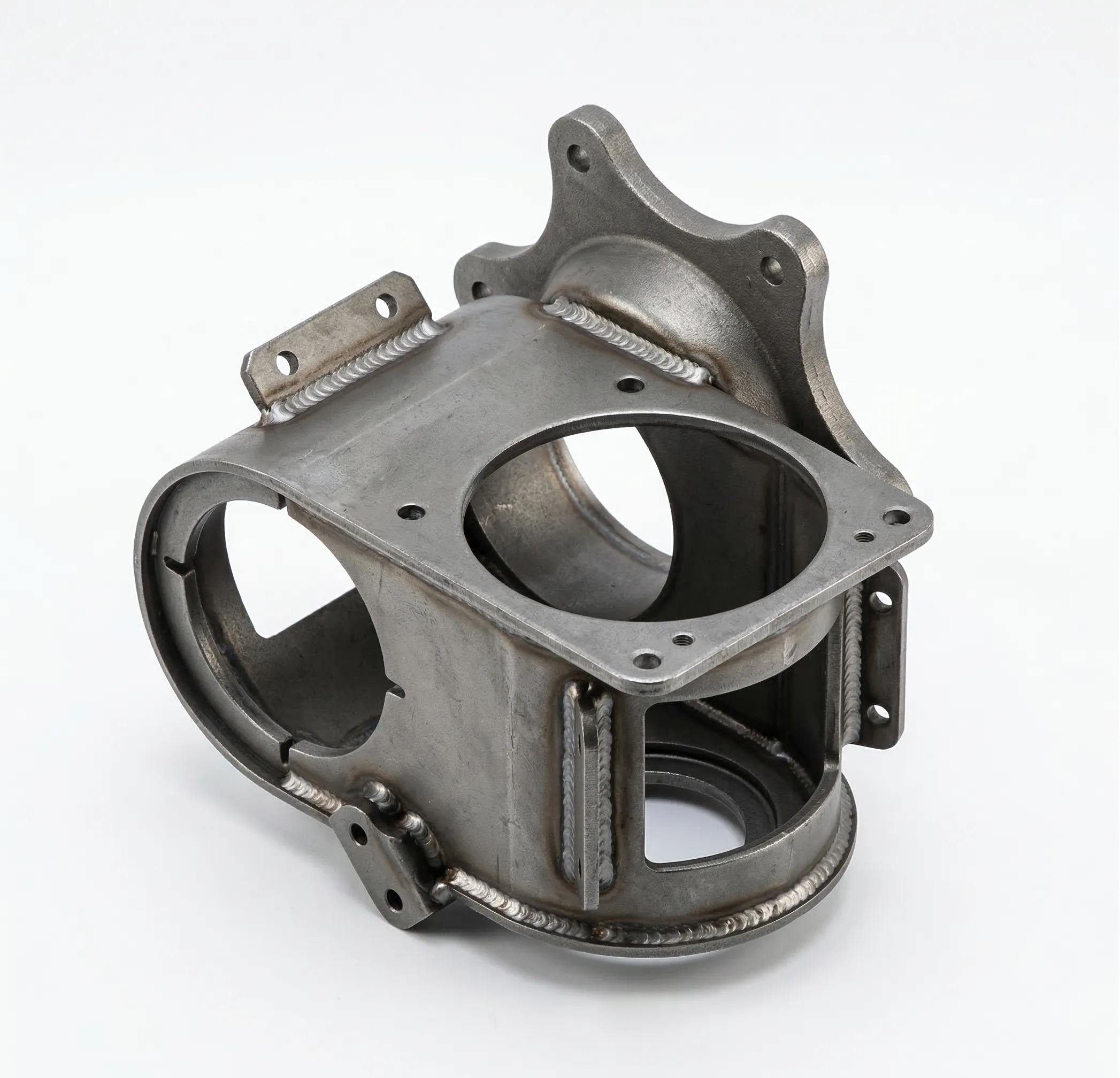
The B0501181-B Large Grain Tank Reversing Body Weldment is a precision-engineered structural component designed for large-capacity grain headers (4.0 m class). Fabricated from Q345B high-strength steel with dual-thickness shell construction (4 mm inner deflector / 6 mm structural), it features mandatory post-weld stress-relief annealing, full-penetration MIG welding, and a three-stage corrosion protection system (Sa 2.5 blast + zinc-rich epoxy primer + powder coat).
Product Specifications
B0501181-B · EVER-POWER Grain Header Structural Division
| Parameter | Specification | Remarks |
|---|---|---|
| Product Name | Large Grain Tank Reversing Body Weldment | Grain-flow direction control assembly |
| Part Number | B0501181-B | B-series large-capacity header variant |
| Primary Material | Q345B Low-Alloy High-Strength Steel | GB/T 1591 certified; yield ≥ 345 MPa |
| Shell Plate Thickness | 4 mm (inner deflector) / 6 mm (structural shell) | Wear-resistant inner lining available |
| Welding Standard | GB/T 12467 / AWS D1.1 CO₂ MIG | Full-penetration on structural joints |
| Post-Weld Treatment | Stress-Relief Annealing 580–620 °C, ≥ 2 h | Residual stress reduced ≥ 70% |
| Machining Tolerance | Key flanges and shaft seats: ±0.3 mm (CMM verified) | Post-anneal CNC finish |
| Approximate Dimensions | Approx. 560 × 320 × 260 mm | B-series standard envelope |
| Net Weight | ≈ 19–22 kg | Excl. deflector inserts and seals |
| Surface Treatment | Sa 2.5 Shot-Blast + Epoxy Primer + Powder Coat | Salt-spray ≥ 480 h (ISO 9227) |
| Mounting Interface | 4× M12 / 2× M14 bolt pattern; flange-face mating | ISO-pitch header frame compatible |
| Applicable Platform | Large-capacity grain tank header, 4.0 m class | Combine harvester and rotary tiller header |
| Standard Colour | Harvester Red (RAL 3020) / Custom RAL on request | OEM colour matching from 10 pcs |
| MOQ / Lead Time | 1 set / 12–18 days ex-works | OEM packing and labelling available |
Functional Role of the Reversing Body in Grain Header Systems
In any large-capacity grain harvesting header, the raw crop stream that arrives from the cutting and threshing zones is a turbulent, high-velocity mixture of grain, chaff, and broken straw. Before this material can enter the grain tank cleanly, its direction and momentum must be controlled and redirected through a series of precisely shaped flow-control surfaces. The reversing body weldment — is the primary structural component that executes this direction change. It forms a welded three-dimensional housing around the grain-flow transition zone, providing the rigid structural envelope within which diverter vanes, auger shafts, and sealing surfaces operate at rated throughput speeds without deflection or vibration that would compromise grain-handling efficiency or cause impact damage to the grain kernel.
The B0501181-B designation indicates this is the B-series large-tank variant — designed for the higher-capacity header platforms where the grain flow rate, auger torque, and vibrational loading are all significantly elevated compared to standard-capacity designs. At peak throughput on a modern combine harvester header operating in heavy paddy or wheat conditions, the reversing body weldment is subjected to continuous grain impact on its inner deflector surfaces, cyclical torsional loads from the auger drive shaft bearings housed within its flanges, and the resonant vibration generated by the primary threshing drum rotating at 800–1,200 RPM immediately upstream. The B0501181-B is specifically rated for this demanding duty cycle through a combination of material specification, post-weld stress relief, and geometric stiffening features that are absent in lower-tier alternatives sourced from the general aftermarket.
EVER-POWER manufactures this header component as part of a dedicated grain-handling structural fabrication programme that covers the complete grain-flow path from the threshing zone exit to the grain tank inlet. Sourcing the reversing body weldment from the same supplier as the adjacent grain tank body panels and auger assemblies ensures dimensional chain compatibility across the entire grain-path interface — a benefit that cannot be achieved when mixing components from different fabrication sources.
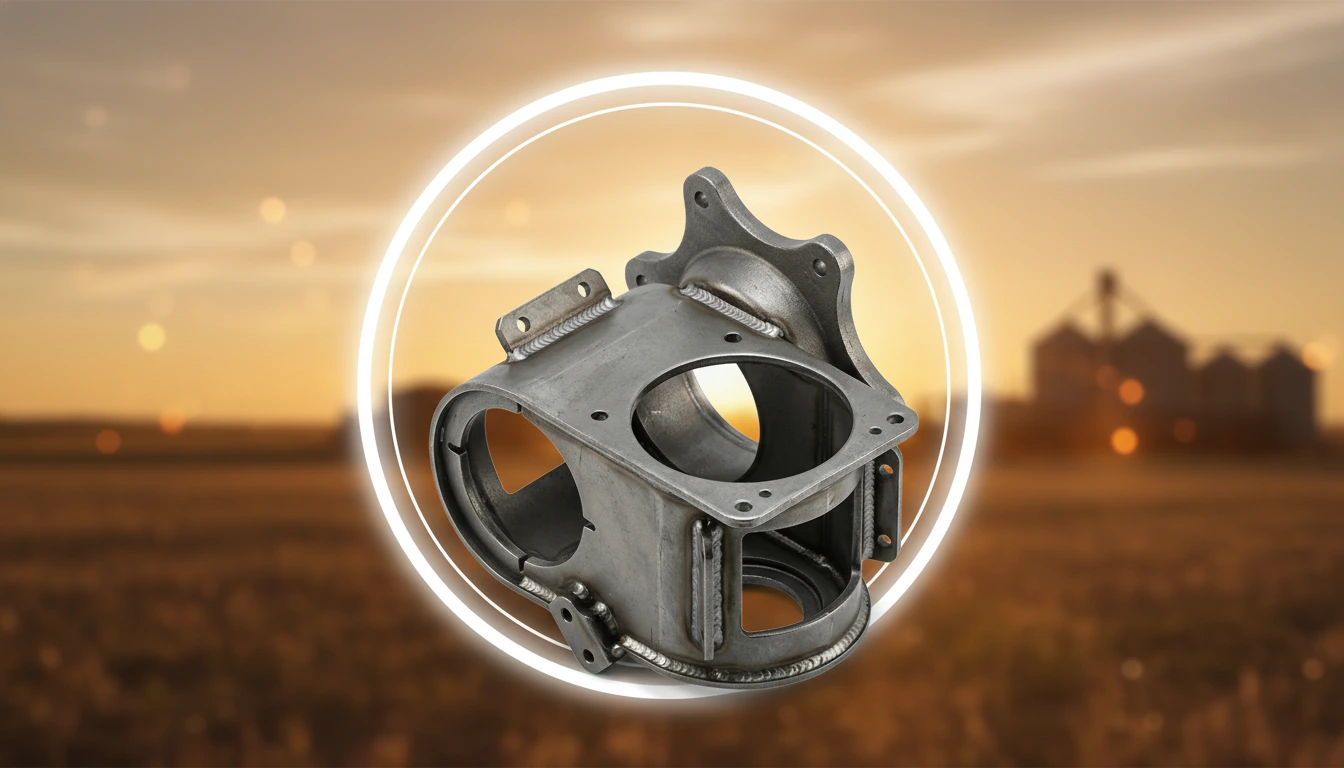
Engineering Features That Drive Field Durability
The grain-handling environment imposes wear, fatigue, and corrosion challenges that appear unremarkable in a parts catalogue but become decisive quality differentiators after two or three seasons of continuous harvesting work. Each design feature described below targets a specific, documented failure mode that EVER-POWER's engineering team identified through returns analysis and distributor field reports.
Mandatory Post-Weld Stress Relief
All B0501181-B weldments undergo stress-relief annealing at 580–620 °C for a minimum of two hours before machining begins. This reduces residual welding stresses by ≥ 70%, preventing the fatigue cracks that appear at weld toes in non-treated weldments after 300–600 hours of harvesting — a timeline short enough to fail within a single season on a combine running extended daily shifts.
Dual-Thickness Shell Construction
The inner deflector surfaces, where continuous grain impact abrades the shell wall, are constructed from 4 mm plate — thicker than the outer structural shell in non-wear zones. This targeted mass placement extends the interval before the inner surface wears through to the structurally critical shell thickness, without adding unnecessary weight to the overall assembly beyond what the wear-loading zones genuinely require.
Post-Anneal CNC Flange Machining
Mating flanges and shaft-seat bores are CNC-machined after the stress-relief anneal, not before. Machining before stress relief allows the subsequent heat treatment to re-distort the critical interface surfaces, producing bolt faces that are not flat and bore centres that are not concentric. EVER-POWER's sequencing maintains flange flatness within 0.3 mm/300 mm and bore centreline accuracy within ±0.3 mm.
Three-Stage Corrosion Protection
Sa 2.5 shot-blast establishes a clean anchor profile (Rz 40–70 µm). Zinc-rich epoxy primer at ≥ 55 µm DFT provides cathodic protection at damage sites. Electrostatic powder topcoat at ≥ 80 µm DFT adds UV stability and mechanical abrasion resistance. The combined system passes 480 hours of neutral salt-spray testing — essential for grain headers operating in humid paddy regions where condensation and crop moisture combine to accelerate corrosion.
Q345B — Fatigue-Optimised Grade
At the cyclic loading frequencies generated by a harvester threshing drum running at 800+ RPM, the fatigue endurance limit is the binding design parameter — not static yield strength. Q345B's 345 MPa yield and 470–630 MPa tensile strength, combined with its lower carbon equivalent (CE ≤ 0.45%), ensure weld-zone toughness is maintained at the low-temperature pre-dawn starts that are common in autumn cereal harvesting across northern China and India's Punjab.
Direct-Replacement Bolt Pattern
The combined M12/M14 bolt-hole pattern is dimensioned to the ISO-pitch grain header frame standard used across the leading large-tank combine platforms, making the B0501181-B a genuine direct-replacement part for the three highest-volume machines in the global 4.0 m large-tank grain header class — eliminating the re-drilling or spacer fabrication that creates grain-path misalignment in non-standard aftermarket substitutes.
Production Sequence & Quality Gates
Eight sequential production stages govern every B0501181-B weldment. Each stage carries defined acceptance criteria, and no part advances until the preceding criteria are met. The critical discipline that separates this weldment from standard aftermarket alternatives is the placement of stress-relief annealing before CNC machining — the sequence that ensures the geometric precision of the machined surfaces is not subsequently distorted by heat-treatment movement.
① Material Incoming Inspection & Batch Release
Q345B plate arrives with GB/T 1591 mill certificates. EVER-POWER's QC team runs independent spectroscopic chemical verification and Brinell hardness spot-checks on every incoming coil before clearing it for production. Any coil that fails the carbon-equivalent check (CE ≤ 0.45%) is quarantined and returned — no waivers are granted at this stage, as CE deviation directly affects weld-zone toughness in the finished part.
② Fibre-Laser Cutting — Shell Panels & Inner Deflectors
A 6 kW fibre-laser platform cuts all outer shell panels, inner deflector plates, and mounting flanges to ±0.2 mm positional accuracy. The laser program distinguishes between the 6 mm structural shell stock and the 4 mm inner-deflector stock, cutting both from a single optimised material layout that minimises scrap. All cut edges on grain-contact inner surfaces are subsequently deburred and radiused to remove micro-notches that would accelerate grain-impact fatigue cracking.
③ Fixture Assembly & Tack-Welding
All panels are loaded into a CNC-machined steel fixture that enforces the nominal assembly geometry to within ±0.5 mm before any tack weld is applied. The fixture design was developed specifically for the B-series reversing body geometry, accounting for the non-symmetric three-dimensional profile of the grain-flow transition zone that makes this weldment more difficult to fixture correctly than simple box-section structural parts. Fixture geometry is CMM-verified at the start of each production batch.
④ Full-Penetration CO₂ MIG Welding
Qualified welders complete all structural welds using CO₂-shielded MIG at currents and travel speeds defined in the pre-qualified procedure qualification record (PQR) for Q345B. Structural joint welds at the flange-to-shell interfaces and the grain-deflector-to-body weld toes receive full-penetration profiles per GB/T 12467. All weld sequences follow a back-step pattern to minimise longitudinal distortion across the 560 mm weldment span.
⑤ Stress-Relief Annealing at 580–620 °C
The completed raw weldment enters a controlled-atmosphere furnace, is ramped to 580–620 °C at a rate preventing thermal shock, and holds at temperature for a minimum of two hours. This duration reduces residual welding stresses in Q345B sections of 4–6 mm thickness by ≥ 70%. Furnace time-temperature data is logged per batch and forms part of the traceability record available to buyers on request. Controlled cooling below 200 °C prevents re-introduction of thermal stress during the cool-down phase.
⑥ CNC Flange Machining & Bore Finishing
The stress-relieved weldment is fixtured on a CNC machining centre. A reference datum face is established first; all mating flanges, bolt-hole spot-faces, and shaft-seat bores are then machined from this single datum to avoid accumulated error. Flange flatness is verified to ≤ 0.3 mm/300 mm; bolt-hole pitch is verified to ±0.2 mm. CMM measurement data for each unit is stored against its production serial number.
⑦ Blast Cleaning & Three-Stage Coating
Machined flanges and shaft bores are masked. The exterior is Sa 2.5 shot-blasted, then zinc-rich epoxy primer is applied at ≥ 55 µm DFT, followed by electrostatic powder topcoat at ≥ 80 µm DFT cured at 185 °C for 20 minutes. Film-thickness spot-checks are taken at six positions per part using a calibrated digital gauge — any reading below specification triggers a rework rather than a pass waiver.
⑧ CMM Final Audit & Export Packing
Each finished part is measured at 10 critical dimensions on a coordinate measuring machine before acceptance. Accepted units receive flange-face protection pads on all machined surfaces, are wrapped in VCI polyethylene film, and packed in formed timber crates with foam inserts protecting the grain-deflector surfaces from transport impact. The CMM report is stored against the unit's QC serial number and included in the export documentation package.
Material Specification & Selection Rationale
The reversing body weldment sits at the intersection of three distinct loading environments — grain impact on the inner deflector surfaces, cyclical bending and torsional loads from the auger shaft bearings, and the resonant vibration transmitted from the adjacent threshing drum. No single material grade is optimal for all three simultaneously. The B0501181-B resolves this through a two-grade shell construction combined with a weld-metal specification that prioritises low-temperature toughness over maximum tensile strength.
Q345B Structural Steel — Shell Body
Q345B provides yield ≥ 345 MPa and tensile 470–630 MPa at the section thicknesses used in the structural shell. Its manganese content (1.0–1.6%) contributes solid-solution strengthening without reducing weldability to the point where preheat becomes necessary for ≤ 12 mm sections — a production-floor advantage that also eliminates the risk of hydrogen-assisted cold cracking at the flanged joints where the design creates high restraint during welding.
ER50-6 Welding Wire — Deposited Metal
AWS ER70S-6 equivalent wire deposits tensile strength ≥ 500 MPa with Charpy impact toughness ≥ 47 J at −20 °C. This low-temperature toughness specification covers the early-morning combine start conditions encountered in China's northern autumn wheat harvest and India's Punjab pre-dawn operations, where weld-metal brittleness is a genuine, if infrequently acknowledged, failure risk in standard welding wire grades.
Epoxy Zinc-Rich Primer — Active Protection Layer
At ≥ 55 µm DFT, the zinc-rich epoxy primer provides cathodic protection at coating damage sites — the zinc particles sacrifice sacrificially, preventing base metal corrosion even when the topcoat is breached by stone impact or crop-stalk abrasion. In grain headers where the inner shell surfaces are continuously abraded by crop material, this cathodic protection layer extends the corrosion-free service life of the weldment substantially beyond what a single-layer topcoat system achieves.
Related Components & System Interfaces
The reversing body weldment is the grain-flow control hub — every component that manages grain movement upstream and downstream of the direction-change zone interfaces with it structurally or functionally. When the weldment is being serviced or replaced, these interfacing components should be inspected and renewed as appropriate to prevent the original failure mode from recurring through a different component within the same service interval.
The main grain tank structural shell to which the reversing body mounts; the reversing body must seat flush against the tank body flange to prevent grain leakage at the joint. Inspect the tank body mating flange for distortion or corrosion pitting whenever the reversing body is removed.
The horizontal auger running inside the reversing body housing, driven by a chain and sprocket from the header gearbox; its shaft runs in the bearing seats of the reversing body flanges. Bearing condition should always be evaluated when the reversing body is disassembled.
Replaceable wear inserts that line the inner deflector surfaces of the reversing body; these are the primary wear items and are designed to be replaced independently of the weldment body when wall thickness approaches the minimum replacement threshold.
EPDM or neoprene gaskets at each mating flange face that prevent grain dust ingress into the bearing cavities and chaff entry into the clean-grain zone; always renewed when the reversing body is disassembled, as re-compression of a used gasket creates leak paths.
The chain that transmits power from the header gearbox to the auger shaft sprocket; chain tension and sprocket wear must be checked whenever the reversing body is serviced, as a slack or worn chain accelerates bearing-load variation that shortens the weldment's shaft-seat service life.
Structural fasteners for the grain-tank-to-reversing-body flange joint; Grade 10.9 is mandatory — Grade 8.8 substitution reduces joint preload by 24% and permits flange micro-movement that damages gasket sealing surfaces and introduces fretting fatigue at the flange bore interface.
Radial lip seals at the auger shaft exit bore faces of the reversing body; prevent grain dust from entering the bearing cavities. Oil seals are always renewed when the auger shaft is withdrawn, as the sealing lip cannot re-seat to its original interference fit after being freed from its running track.
The structural side plate of the header frame to which the reversing body sub-assembly bolts; impact damage to the side-panel mating face creates flange-gap misalignment that prevents the gasket from sealing correctly even after a perfect reversing body replacement installation.
Machine Compatibility & Fitment Reference
The B0501181-B's bolt-hole pattern and grain-path flange geometry correspond to the standard large-tank grain header configuration used on the major combine harvester and rotary tiller header platforms in the 4.0 m class. Dimensional confirmation data from distributor surveys is provided below. For platforms not listed, email the header frame drawing or OEM part number to sales@hzpt.com for a free pre-order dimensional check.
| Brand / Platform | Header Class | Status | Notes |
|---|---|---|---|
| Kubota DC Series (Large-Tank) | 4.0 m LT | DIRECT FIT | Confirmed 2018–2024 production series |
| Yanmar AW-Series Large-Tank | 4.0 m LT | DIRECT FIT | Verify shaft-seat bearing type before order |
| Claas Dominator 4.0 m Header | 4.0 m LT | MINOR ADAPT. | Two M12 holes re-drill ±6 mm; send drawing for check |
| Dongfeng / LOVOL LT Header | 4.0 m LT | DIRECT FIT | Standard GB bolt pattern; most common domestic platform |
| Maschio Gaspardo Large-Tank | 4.0 m LT | CONFIRM DIMS | Submit dimensional drawing; free pre-check provided |
| Generic ISO-Pattern LT Frames | 4.0 m LT | SEND DRAWING | 1-day response; free dimensional analysis |
Step-by-Step Replacement Procedure
Replacing the reversing body weldment on a large-tank grain header is a technically more demanding task than swapping a simple guard or cover, but it is achievable in a well-equipped farm workshop over a full working day with two technicians. The procedure below reflects best practice compiled from dealer feedback across China, India, and Southern Europe's main grain harvest regions.
Lock-Out & Header Preparation
Disengage all drives, switch off engine, remove key, and block the header on stands before any access to the grain-path zone. Drain remaining grain from the tank and reversing body housing. Photograph all chain, shaft, and seal assemblies in their fitted positions before disassembly to prevent re-assembly errors.
Disconnect Drive Chain & Auger Shaft
Remove the chain at the quick-link after confirming both shafts are stationary. Withdraw the auger shaft using a puller — impact driving risks distorting the shaft-seat bores in the weldment. Tag the shaft's fitted orientation and record its axial position measurement for reference during reassembly.
Unbolt Flange Connections
Remove all fasteners from the grain-tank-to-reversing-body flange and the header-frame-to-reversing-body mounting faces. If bolts are seized by rust, apply penetrating fluid and allow 15 minutes — forcing seized Grade 10.9 bolts risks shearing the head and leaving the stud in place, which substantially increases repair time.
Remove & Inspect Old Weldment
With a second person supporting the 19–22 kg weldment, ease it free of the grain-path gaskets before lifting clear. Lay the removed weldment flat and inspect the inner deflector surfaces using a calibrated wear gauge — if inner wall thickness has reached ≤ 2 mm at any point, record the wear location for root-cause analysis before ordering replacement vane inserts.
Prepare Mating Surfaces & Install Gaskets
Wire-brush and degrease all mating flange faces on the grain tank and header frame. Check flatness with a precision straight-edge — any deviation exceeding 0.5 mm must be corrected by machining before the new weldment is fitted. Fit new EPDM gaskets onto the cleaned surfaces; apply a light smear of gasket adhesive to the outer perimeter only to assist positioning during installation.
Install, Torque & First-Run Verify
Engage all fasteners finger-tight first to confirm alignment without forcing. Torque M12 bolts to 90 N·m and M14 bolts to 135 N·m in a cross-diagonal sequence across three stages. Reinstall auger shaft and chain; set chain tension per the machine specification. Run the header at low speed for 3 minutes and inspect all flange joints for grain leakage before returning to full operational speed.
Industry Applications & Machine Deployment
As a grain-flow control component, the B0501181-B reversing body weldment is relevant wherever large-volume crop material must be redirected and channelled under mechanical throughput pressure. Its structural architecture is directly analogous across a broader range of machinery types than its origin in cereal harvesting might initially suggest.
Maintenance Schedule & Inner-Wall Wear Monitoring
The reversing body weldment has two distinct maintenance requirements: the structural body inspection programme, which is an interval-based inspection regime similar to other structural weldments; and the inner-wall wear monitoring programme, which is specific to grain-handling components and tracks the progressive thinning of the deflector surfaces from grain-impact abrasion. Both are required to catch the two distinct failure modes — fatigue cracking and wear-through — before they occur.
Every 50 h
- Inspect all external weld toes visually for surface cracks, especially at flange-to-shell joints
- Check all fasteners are fully seated — torque-check a random 3 bolts per flange face
- Look for grain dust at any external flange joint — indicates gasket failure requiring immediate attention
- Check chain tension and sprocket condition on the auger drive
Every 200 h
- Remove access panels and measure inner deflector surface thickness using an ultrasonic gauge
- Record measurements at the five highest-wear locations; compare to previous season records
- Re-torque all mounting fasteners to specification after initial settling period
- Inspect auger shaft for fretting at bearing-seat contact zones
- Replace oil seals if any surface weep or grain dust accumulation is visible at shaft exits
End of Season
- Pressure-wash the interior grain-path surfaces; allow to dry completely before storage
- Apply rust-inhibitor spray to any bare steel visible through coating damage
- Document and photograph any new crack indications for comparison against next season
- Replace deflector vane inserts if measured wall thickness is within 1.5 mm of the minimum threshold
- Drain any standing water from internal cavities before winter storage to prevent freeze-expansion damage
Inner Wall Minimum Thickness — Replace at ≤ 2 mm:
Once the inner deflector wall falls below 2 mm at any point, the remaining section reserve is insufficient to absorb the impact energy of a high-velocity grain stream without risk of perforation. Perforation of the inner wall allows grain to enter the structural shell void, where it accumulates moisture, accelerates internal corrosion, and eventually leads to structural shell failure from the inside — a failure mode that is extremely difficult to detect before it causes the complete collapse of the grain-flow path integrity. Do not operate a reversing body weldment in which inner-wall thickness has reached the 2 mm threshold at any location.
Market Pricing & Five-Year Value Comparison
The aftermarket for reversing body weldments spans a significant price range across supply tiers, but unit price is a poor predictor of total cost of ownership because the inner-wall wear rate, which determines how often the component is replaced, varies substantially between tiers. A component that wears through in one season at low unit cost can generate higher total costs over five seasons than a higher-priced component that runs reliably for three or more seasons. The analysis below uses a 5-season horizon at 300 harvesting hours per season.
| Supply Tier | Unit Price (USD) | Body Life (Seasons) | Insert Replacements / 5 Yr | 5-Year TCO (USD) |
|---|---|---|---|---|
| OEM Factory Part Via authorised dealer channel |
$380 – $560 | 4 – 6 | 2 – 3 | $520 – $780 |
| Premium Aftermarket Established brand, stress-relieved |
$195 – $310 | 3 – 5 | 3 – 4 | $340 – $520 |
| EVER-POWER B0501181-B ★ Factory-direct, stress-relieved, dual-thickness inner shell |
$145 – $220 | 4 – 6 | 2 – 3 | $240 – $380 |
| Generic / Non-Stress-Relieved No material cert., no anneal record |
$45 – $90 | 0.5 – 1.5 | 5 – 8 | $480 – $860 |
Prices are indicative ex-works; exclude freight and import duties. TCO includes weldment unit cost plus deflector insert replacement costs. Contact sales@hzpt.com for current volume-tier pricing.
Sustainability, Compliance & Key Export Markets
Agricultural machinery components exported from China into the major grain-producing markets increasingly face material traceability, welding procedure qualification, and environmental compliance requirements as conditions of entry into government-supported equipment subsidy programmes. EVER-POWER maintains the complete compliance infrastructure to support distributors across each of these regulatory environments.
China — Primary Production Market
China is the world's largest producer and domestic consumer of large-capacity combine harvester headers, with the 4.0 m large-tank class being the dominant format in the Yangtze and Yellow River grain belts. EVER-POWER materials are procured against GB/T 1591 mill certificates. The ISO 9001:2015 production facility satisfies the documentation requirements of China's agricultural machinery purchase subsidy programme. Steel scrap from laser-cutting operations is 100% recycled through contracted mills, reducing embodied carbon per unit by approximately 28% compared to primary steel sourcing.
EU — CE Directive Compliance
EU Machinery Directive 2006/42/EC requires structural grain-handling components to meet minimum design and manufacturing standards. EVER-POWER supplies welding PQR documentation, material declarations, and dimensional drawings suitable for CE technical file preparation. Italy and France — Europe's largest combine harvester markets — are the top EU buyers of this component category. The part complies with EU REACH Regulation 1907/2006 and contains no SVHC substances in its coating materials.
India, Thailand & Vietnam
South and Southeast Asia represent the fastest-growing export segment for B0501181-B weldments, driven by large-scale mechanisation of paddy rice and wheat harvesting. BIS (India) and TCVN (Vietnam) import documentation requirements for HS Code 8433.90 are bundled into EVER-POWER's standard export package, reducing customs clearance complexity for regional distributors. Thailand's growing large-tank combine market — driven by rice paddy consolidation in the central plains — is a key secondary growth market for this component.
Environmental Position
Powder coating at EVER-POWER uses zero-VOC formulations. Shot-blast wastewater is processed through a closed sediment-filter loop meeting China GB 8978 discharge standard. The B0501181-B's 4–6 season service life under normal harvesting conditions directly reduces the material consumed per unit of grain output by replacing shorter-lived alternatives less frequently — a tangible embodied-carbon reduction that supports agricultural operations seeking to meet scope-3 supply-chain sustainability targets.
EVER-POWER vs. Market Alternatives
Seven measurable technical dimensions separate the EVER-POWER B0501181-B from the competing supply tiers. These are the dimensions a technically informed procurement manager or workshop manager should verify when qualifying any reversing body weldment supplier — and the dimensions on which cost-driven alternatives consistently fall short.
| Evaluation Criterion | OEM Brand | Generic Aftermarket | EVER-POWER |
|---|---|---|---|
| Material Grade & Cert | Proprietary / certified | Often Q235, no cert | Q345B, GB/T per batch |
| Post-Weld Stress Relief | Most platforms | Rarely performed | Mandatory, furnace-logged |
| Dual-Thickness Inner Shell | Design-dependent | Uniform thin shell | 4 mm impact / 6 mm structural |
| CNC Flange Machining | ≤ 0.3 mm | Uncontrolled | ≤ 0.3 mm, post-anneal, CMM |
| Corrosion System | Powder coat | Single coat air-dry | Zinc primer + powder ≥ 480 h SST |
| Weld PQR Available | Yes | No | Yes, per batch on request |
| OEM / Private Label | No | Limited | Full OEM from 5 units |
Customer Success Cases & Field Performance Data
The following three case summaries are drawn from distributor field reports and direct end-user correspondence submitted over the 2021–2024 harvesting seasons. Each addresses a distinct operational environment and a specific performance dimension of the B0501181-B weldment.
Frequently Asked Questions
Technical and procurement guidance for the B0501181-B. For dimensional pre-checks or engineering queries, contact sales@hzpt.com.
Quality Documentation Available
Mill test certs · Furnace stress-relief records · Welding PQR · CMM inspection reports · Salt-spray test certificates — available per batch on request.

We promise will offer the best price by the high quality in china! We also accept special order about the products. If you are interested in our products. Please do not hesitate to let us know.We are pleased to give you the detailed information.We promise that our products would be safety and were in high quality and reasonable price. If you are interested in our products, please contact us asap.We are sincerely looking for your cooperation.
Most of our products are exported to Europe or Americas, both standard and nonstandard products available. We can produce as per your drawing or sample. Material can be standard or as per your special request. If you choose us, you choose reliable.
Industries We Service
