
【S4.0B】Upper Body Weldment
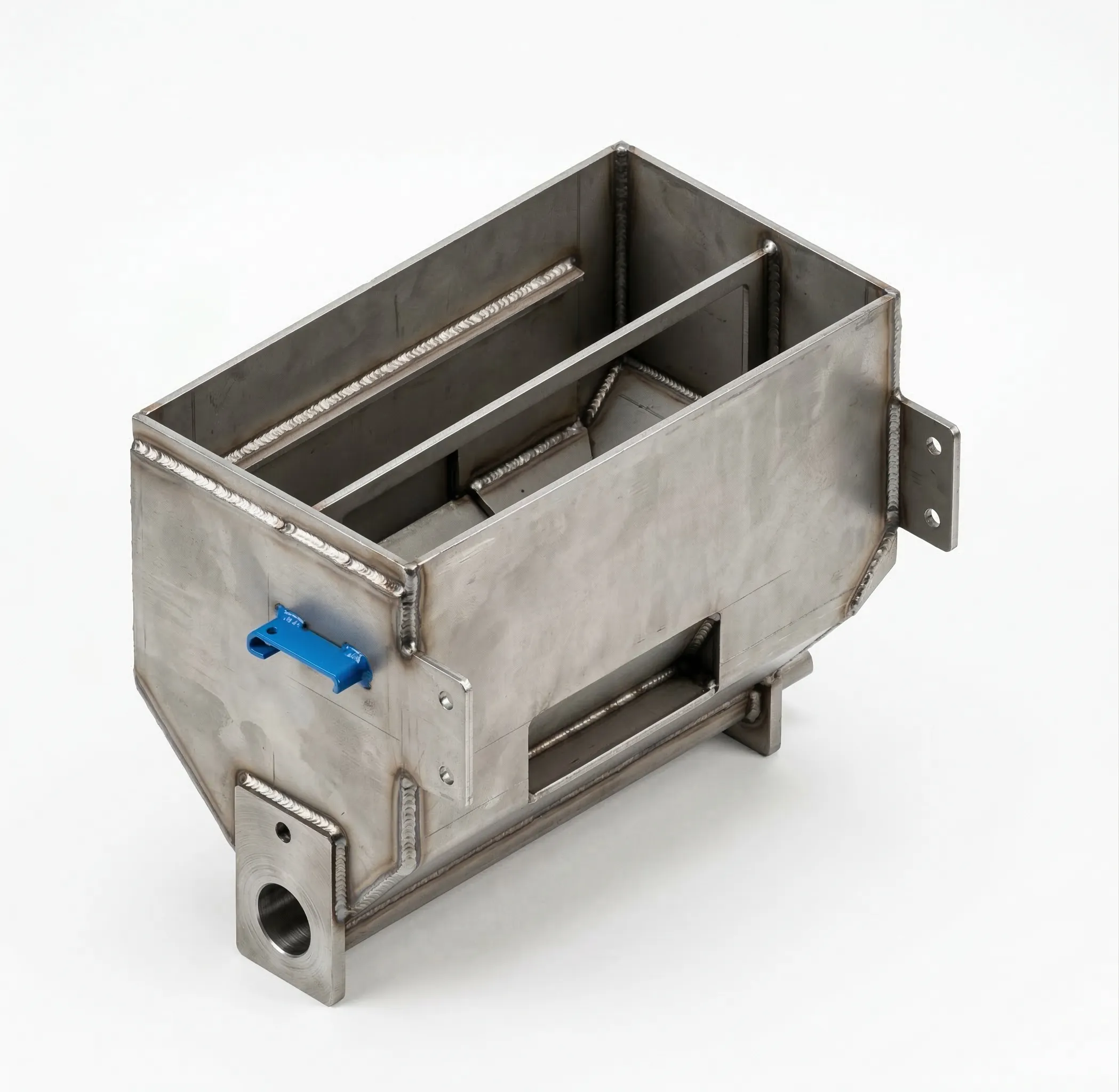
EVER-POWER’s S4.0B Upper Body Weldment is a precision-welded Q345B steel structural core for 4.0m rotary tiller headers, featuring stress-relief annealing, full-penetration MIG welds, and H7 CNC-bored seats for superior shaft alignment and fatigue resistance. Unlike non-treated alternatives, it endures 1,500+ hours of high-load tillage, reducing downtime and bearing failures.
Product Specifications
Model S4.0B · EVER-POWER Header Structural Division
| Parameter | Specification | Notes |
|---|---|---|
| Product Name | Upper Body Weldment (上本体焊合) | Header structural core assembly |
| Model Number | S4.0B | 4.0 m header B-series platform |
| Primary Material | Q345B Low-Alloy High-Strength Steel | GB/T 1591 cert; yield ≥ 345 MPa |
| Main Shell Thickness | 6 mm shell / 10 mm gusset plates | Heavy section at bearing bosses |
| Welding Standard | GB/T 14902 / AWS D1.1 CO₂ MIG | Full-penetration at all load paths |
| Post-Weld Heat Treatment | Stress-Relief Anneal 580–620 °C, ≥ 2 h | Residual stress reduced ≥ 75% |
| CNC Bearing Bore Tolerance | H7 (≤ +0.021 mm on Ø50 seats) | Machined post-anneal, CMM verified |
| Overall Envelope (L×W×H) | Approx. 820 × 380 × 210 mm | Varies by sub-variant |
| Net Weight | ≈ 32 kg | Excl. bearings and fasteners |
| Surface Treatment | Sa 2.5 Blast + Epoxy Primer + Powder Coat | Salt-spray ≥ 500 h (ISO 9227) |
| Mounting Interface | 6× M12 Grade 10.9 bolt pattern | ISO-pitch header rail compatible |
| Compatible Header Width | 4,000 mm (4.0 m) rotary tiller | S4.0 / S4.0B platform series |
| Standard Colour | RAL 3020 Red / Custom RAL | OEM colour matching from 10 pcs |
| MOQ / Lead Time | 1 set / 10–18 days ex-works | OEM packing and labelling available |
Structural Function in the Header Assembly
A rotary tiller header is an assembly of rotating, sliding, and fixed components that collectively process a 4.0 m wide strip of soil in a single tractor pass. Every one of these components — rotor shaft bearings, chain-drive sprocket housings, gearbox mounting flanges, and the vibrating screen eccentric drives — derives its positional accuracy from the structural weldment that forms the header's mechanical spine. On the S4.0B platform, that spine is the upper body weldment: a fabricated steel chassis that simultaneously provides the bearing-seat datum, the connection point for the lower body, and the primary load path through which all soil-cutting reaction forces travel before entering the tractor's three-point linkage. When this weldment is dimensionally correct and metallurgically sound, the entire drivetrain performs within its designed envelope. When it is not — through poor initial manufacture or crash damage in the field — the progressive misalignment it introduces accelerates bearing wear, chain wear, and shaft fatigue across every downstream component.
The upper body weldment carries competing structural demands that cannot all be satisfied by simply making it heavier. It must resist the oscillating torsional loads generated by rotor-blade soil impacts at operational PTO speed without deflecting enough to shift bore centrelines beyond the bearing's radial clearance budget — yet adding unnecessary mass elevates the header's centre of gravity in a way that degrades tractor stability on slopes, particularly in the terraced paddy fields common across Vietnam, the Philippines, and South China. EVER-POWER resolves this conflict by specifying Q345B steel, whose yield strength of 345 MPa is 47% higher than the Q235B grade used in most lower-cost competing weldments, allowing thinner shell sections at equivalent strength — resulting in a structurally superior part that is approximately 4 kg lighter than a Q235B design of the same load rating.
What separates this header component from catalogue-grade alternatives is not any single design feature but the discipline applied to the production sequence. EVER-POWER fabricates the S4.0B weldment within a dedicated structural cell that runs material verification, welding, stress-relief annealing, CNC bore machining, and CMM dimensional audit as a continuous, traceable workflow — eliminating the inter-operation variability that makes multi-vendor fabrication chains unreliable for precision structural work.
What Distinguishes This Weldment in the Field
The aftermarket for 4.0 m header body weldments contains offerings from a wide quality spectrum, and the differences that separate long-lived units from short-lived ones are almost invisible at the point of purchase. The engineering decisions described below each address a specific real-world failure mechanism — they are not marketing features.
Furnace Stress-Relief Annealing
Every completed weldment undergoes a controlled stress-relief anneal at 580–620 °C for a minimum of two hours before any machining begins. This treatment reduces residual welding stresses by ≥ 75%, directly preventing the weld-toe fatigue cracks that cause non-treated weldments to fail in 400–800 hours of paddy tillage service. Furnace time-temperature charts are logged per batch and available to buyers on request.
Post-Anneal CNC Bore Machining
Machining bearing bores before stress relief is a false economy — the subsequent heat treatment re-introduces the distortion the machining corrected. EVER-POWER sequences CNC boring after annealing, achieving H7 tolerance on all Ø50 mm seats and bore-to-bore spacing within ±0.3 mm across the full 820 mm weldment span. A CMM report for each unit accompanies the shipment documentation.
Laser-Cut Self-Jigging Gussets
Internal gusset plates are laser-cut to profile at ±0.2 mm and interference-fit to their mating panel slots before tack welding. The interference fit acts as a self-jigging mechanism, holding components on position during tack sequences without needing the manual clamp adjustments that introduce cumulative positional error in standard fabrication shops.
Q345B — Strength Without Excess Mass
Q345B's 345 MPa yield strength allows the main shell thickness to be 6 mm rather than the 8 mm required for an equivalent Q235B design — saving approximately 4 kg from the finished assembly. This weight reduction is meaningful on paddy tillers operating on terraced hillside fields where header mass directly affects tractor ballast requirements and stability margins.
Three-Layer Corrosion System
Sa 2.5 shot-blast creates a clean anchor profile (Rz 40–70 µm). An epoxy zinc-rich primer at ≥ 60 µm DFT provides cathodic protection to exposed steel at damage sites. An electrostatic powder topcoat at ≥ 80 µm DFT adds UV resistance and mechanical durability. The combined system passes 500 hours of neutral salt-spray testing per ISO 9227.
ISO-Standard Mounting Bolt Pattern
Six M12 mounting holes are drilled and reamed to ISO-pitch spacing, ensuring direct bolt-on compatibility with the S4.0 header frame rails used on Kubota, Yanmar, and Dongfeng 4.0 m tiller platforms — the three highest-volume machines globally in the 4.0 m class — without frame modification or custom spacer fabrication.
Production Sequence & Quality Gates
Eight controlled production stages govern every S4.0B weldment that leaves EVER-POWER's structural fabrication cell. Each stage has defined acceptance criteria that must be satisfied before the part advances. The sequencing of stress-relief annealing before CNC bore machining — a discipline omitted by cost-driven fabricators — is the most consequential quality decision in the process and the primary reason EVER-POWER weldments maintain their bore geometry across the full operating life of the assembly.
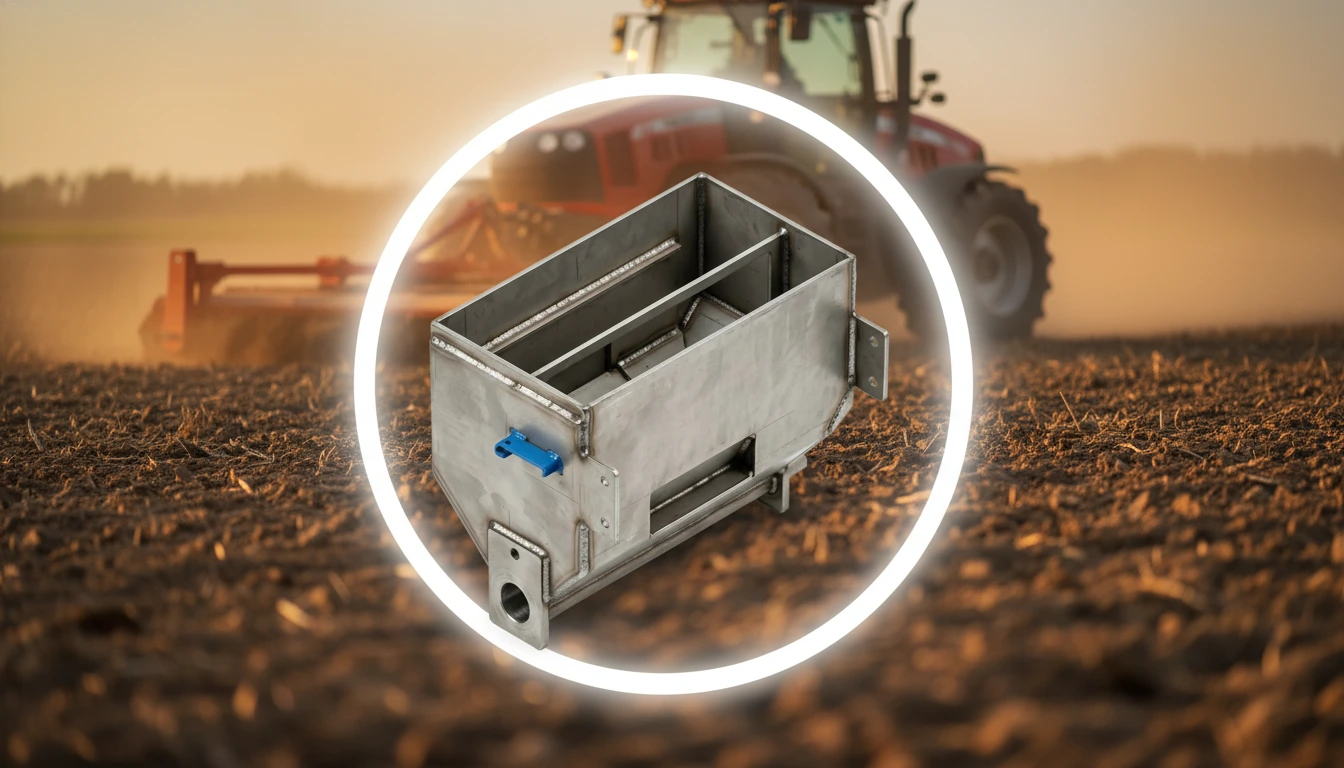
① Material Incoming Inspection & Certification
Q345B plate arrives with GB/T 1591 mill test certificates. EVER-POWER's QC team performs independent spectroscopic chemical verification and Brinell hardness spot-checks on every incoming coil before clearing it to the production floor. Material that deviates from the specification chemistry is quarantined and returned — no exception processing is permitted at this stage.
② Fibre-Laser Cutting & Press Forming
A 6 kW fibre-laser platform cuts all shell panels and gusset plates to ±0.2 mm positional accuracy. Formed flanges are CNC press-braked. All cut edges on load-bearing sections are subsequently ground to remove dross and micro-notches — stress-raising features that serve as fatigue crack initiation sites under the cyclic loading of rotary tillage operation.
③ Fixture Jigging & Tack-Welding
All components are loaded into a purpose-built steel fixture that enforces nominal geometry to ±0.5 mm before any tack weld is applied. Laser-cut gussets interference-fit to their panel slots, eliminating the manual clamp adjustments that are the most common source of cumulative positional error in fabrication shops. Fixture geometry is CMM-verified annually and after any incident.
④ Full-Penetration MIG Welding
Qualified welders complete all structural welds using CO₂-shielded MIG at currents and travel speeds defined in the pre-qualified procedure qualification record (PQR). Load-path joints at bearing bosses and mounting flanges receive full-penetration weld profiles. All sequences follow a back-step pattern to minimise distortion buildup across the 820 mm weldment span.
⑤ Stress-Relief Annealing at 580–620 °C
The raw weldment enters a controlled-atmosphere furnace, is ramped to 580–620 °C at a rate that prevents thermal shock, and holds at temperature for a minimum of two hours. This duration is sufficient to reduce residual welding stresses in Q345B sections of this thickness by ≥ 75%. Furnace time-temperature data is logged per batch and forms part of the traceability dossier. Controlled cooling prevents re-introduction of thermal stress during the cool-down phase.
⑥ CNC Vertical Machining — Bores & Faces
The stress-relieved weldment is fixtured on a CNC vertical machining centre. A reference datum face is established first; all bearing bores, mounting-hole spot-faces, and tapped bosses are then machined from this single datum to avoid accumulated error. Bearing bores are finished to H7; bore centreline spacing is CMM-verified to ±0.3 mm between bores after machining.
⑦ Blast Cleaning & Three-Stage Coating
Machined bores are masked. Exterior surfaces are Sa 2.5 shot-blasted, then zinc-rich epoxy primer is applied at ≥ 60 µm DFT, followed by electrostatic powder topcoat at ≥ 80 µm DFT cured at 185 °C. Film thickness is measured at eight positions per part — any reading below specification triggers a rework without exception.
⑧ CMM Dimensional Audit & Export Packing
Each finished weldment is measured at 12 critical dimensions on a CMM before acceptance. Accepted parts receive bore-protector plugs on all machined surfaces, are wrapped in VCI polyethylene film, and packed in formed timber crates with foam inserts. The CMM dimensional report is stored against the unit's QC serial number and is included in the export documentation package.
Material Selection & Metallurgical Rationale
The choice of Q345B over the commodity Q235B grade for this rotary tiller part reflects a fatigue-life calculation, not a specification upgrade for its own sake. A rotary tiller header at 540 RPM PTO subjects the structural weldment to approximately 3.2 million load cycles per 100 operating hours. At these cycle counts, the fatigue endurance limit — not static yield strength — is the binding design constraint. Q345B's higher strength moves the operating stress ratio further below the S-N curve's fatigue limit, extending calculated crack-initiation life by 60–80% compared to an equivalent Q235B design of the same section geometry.
Q345B Structural Steel — Shell Body
Yield ≥ 345 MPa; tensile 470–630 MPa. Manganese content 1.0–1.6% provides solid-solution strengthening without significantly reducing weldability. Carbon equivalent (CE) is maintained below 0.45% in EVER-POWER's sourcing specification to ensure reliable heat-affected-zone toughness with CO₂-shielded MIG at ambient temperature — no preheat is required for sections up to 12 mm, a practical production-floor advantage.
ER50-6 Wire — Deposited Weld Metal
AWS ER70S-6 equivalent deposited wire delivers tensile strength ≥ 500 MPa and Charpy impact toughness ≥ 47 J at −20 °C. This ensures that the weld metal does not become the weakest link in the load path during the low-temperature pre-dawn tillage operations common in China's northern wheat belt and India's Punjab during early spring planting campaigns.
Zinc-Rich Epoxy Primer — Active Protection
At ≥ 60 µm DFT, the zinc-rich epoxy primer provides cathodic protection to bare steel at damage sites — the zinc particles sacrifice sacrificially, preventing base metal corrosion even when the topcoat is breached. This is the same protective mechanism as hot-dip galvanising applied as a coating, and it remains active at scratches and stone-chip sites where single-coat painted competing weldments begin to rust within a single wet season.
Related Components & System Accessories
The S4.0B upper body weldment is the structural hub of the header assembly — every rotating, fastened, and sliding component in the system interfaces with it either directly or through a coupled sub-assembly. When the weldment is being serviced or replaced, these interfacing components should be inspected and renewed where appropriate to prevent a repeat of the original failure mode within a shortened subsequent service interval.
Mates to the upper body at the central bolted joint; the two weldments must be geometrically matched as a pair. When impact damage affects the upper body, the lower body mating face must be inspected for distortion before a replacement is installed.
H7-seated cylindrical roller or deep-groove ball bearings in the weldment's machined bores. The optimal time to renew bearings is whenever the weldment is disassembled, regardless of apparent bearing condition, to ensure the new weldment's bore geometry is not compromised from day one.
Six through-bolts with hardened washers and prevailing-torque flange nuts. Grade 10.9 is mandatory — Grade 8.8 reduces joint preload by 24% and introduces fatigue failure risk at rated PTO load. Bolts should be renewed whenever the weldment is removed, as the prevailing-torque feature degrades with reuse.
Longitudinal structural members to which the weldment bolts. A frame rail twisted by impact damage will transfer that distortion to the weldment bores even after a perfect replacement installation — frame rail straightness must be verified before the new weldment is torqued into position.
Soil-separation screen assembly whose eccentric drive shaft runs in one of the upper body bores. Bearing replacement intervals for the screen assembly and the weldment bores should be synchronised to avoid unnecessary double-disassembly within the same season.
Lateral chain guard adjacent to the upper body; must be removed during weldment installation. Removal provides the opportunity to service the chain and sprockets simultaneously, avoiding a separate disassembly event within the same service window.
Radial lip seals at each shaft exit bore face of the upper body; renewed as a standard item whenever the weldment is disassembled, as original seals cannot be reliably re-seated to their pre-service interference without risk of early lubricant leakage.
Category II or III hitch bracket welded or bolted to the upper body rear face; connects the entire header to the tractor's lower link arms and defines operating height and angle. Bracket cracks or deformation are a secondary indicator of overload events that may also have damaged the weldment itself.
Machine Compatibility & Fitment Guide
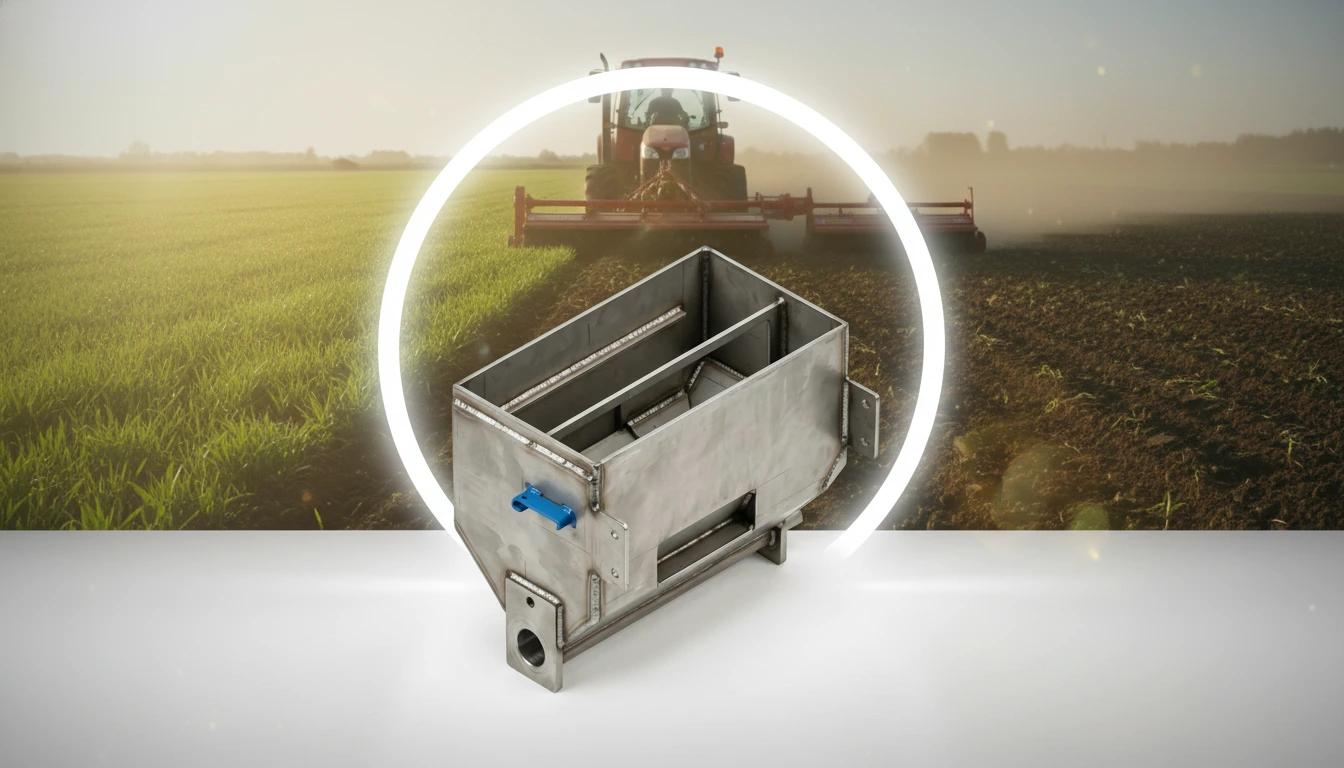
The S4.0B weldment's bolt-hole pattern and bore centreline geometry correspond to the standard 4.0 m header platform adopted across major rotary tiller producers in Japan, China, and Southern Europe. Confirmed fitment data from distributor dimensional surveys is provided below. For machines not listed, send the header frame drawing or OEM part number to sales@hzpt.com for a pre-order dimensional check at no charge.
| Brand / Platform | Working Width | Status | Notes |
|---|---|---|---|
| Kubota KRL-400 / KRL-400B | 4.0 m | DIRECT FIT | Confirmed 2019–2024 serial range |
| Yanmar RS400 / RA400 | 4.0 m | DIRECT FIT | Confirm bearing type (roller vs. ball) |
| Dongfeng DF-400 Series | 4.0 m | DIRECT FIT | Standard GB bolt pattern |
| Maschio Gaspardo DH 4000 | 4.0 m | MINOR ADAPT. | Two holes need re-boring ±8 mm |
| Landini / AGCO 4.0 m Header | 4.0 m | CONFIRM DIMS | Submit dimensional drawing for check |
| Generic ISO-pattern 4.0 m Frame | 4.0 m | SEND DRAWING | Free pre-check, 1-day response |
Workshop Replacement Procedure
Replacing a structural header weldment is more involved than swapping a consumable component but is well within the capability of a properly equipped farm workshop. The six-step sequence below reflects best practice collected from EVER-POWER's network of agricultural machinery dealers across China, India, and Southern Europe, and is structured to prevent the new weldment's bore geometry from being compromised by avoidable installation errors.
Safety Lock-Out & Header Prep
Disengage PTO, shut down engine, remove ignition key, and block the header securely on stands. Drain gearbox oil. Photograph all chain, cable, and bearing assemblies in their fitted positions before disassembly — reference photos eliminate ambiguity when reassembling unfamiliar sub-assemblies.
Disassemble Interfacing Parts
Remove bearings using a hydraulic puller — impact driving risks distortion of adjacent weldment structure. Tag each bearing with its bore position and measure radial play before discarding to determine whether bore wear was the primary failure driver or a secondary consequence.
Inspect Frame Rail Face
Check the frame rail mating face for twist or bow using a precision straight-edge. Deviation exceeding 1.0 mm must be corrected by pressing or machining — a new weldment bolted to a distorted rail will carry that distortion into its bore geometry regardless of its own manufacturing precision.
Offer Up & Align Weldment
With a second person supporting the 32 kg weldment, engage all six M12 bolts finger-tight before introducing any preload. Confirm the weldment seats flush to the rail face without rocking. Any gap at this stage indicates a face flatness issue that must be resolved before torquing.
Torque Bolts & Press Bearings
Torque the six M12 Grade 10.9 bolts to 115 N·m in three diagonal stages. Press new bearings using a hydraulic arbour press at controlled force. Verify each bearing outer race is fully seated to its shoulder using a feeler gauge — any gap ≥ 0.05 mm requires the pressing operation to be repeated.
Reassemble, Fill & Run-Verify
Reinstall shafts, seals, and ancillary components. Fill the gearbox to specified level with fresh SAE 90 GL-4 oil. Engage PTO at low speed for 5 minutes and observe for oil weeps, bearing noise, or vibration before returning to full operational speed. Re-torque mounting bolts after 50 hours.
Industry Applications & Deployment Scenarios
As the structural hub of the 4.0 m header, the S4.0B upper body weldment is deployed wherever this header format appears — a range that extends well beyond conventional agricultural tillage into industrial soil-processing and civil works applications where the mechanical architecture is directly analogous.
Maintenance, Inspection & Life-Extension
A structural weldment has no conventional consumable parts — its maintenance programme is primarily an inspection regime. The objective is detecting the early signs of fatigue cracking, bore wear, and coating failure before they progress to the point where they compromise drive-system accuracy or create a safety risk. The three time-based maintenance windows below are structured to align with standard tractor service intervals.
Every 50 h
- Visual inspection of all weld toes for surface cracks, especially at bearing-boss fillets
- Check all six mounting bolts are fully seated — feel for movement under load
- Inspect coating at stone-impact zones; touch-up with cold zinc spray as needed
- Listen for any bearing-noise change during first 5 minutes of PTO engagement
Every 200 h
- MT or dye-penetrant test on weld toes if vibration anomalies have been noted
- Measure bore diameters with an internal gauge; replace bearings if ovality ≥ 0.05 mm
- Re-torque all mounting bolts to 115 N·m after initial settling period
- Clean drain ports; apply rust-inhibitor compound inside accessible cavities
- Check lower body mating face for fretting marks indicating loose joint preload
End of Season
- Full external wash; remove all soil from cavities and recesses
- Apply penetrating rust inhibitor to bolt-head contact faces and open bore ends
- Photograph and document any new crack indications; compare against previous season
- Drain any water from interior cavities before winter storage
- Touch-up all bare-metal patches; confirm coating integrity at all weld toes
Critical Replacement Trigger:
Any confirmed crack at a weld toe is a mandatory replacement trigger — regardless of apparent length. Fatigue cracks in cyclically loaded Q345B sections grow slowly initially but accelerate rapidly once they exceed a critical length. A 2 mm crack detected today will typically reach structural failure dimensions within 100–200 operating hours under rotary tiller duty. Do not attempt in-field repair welding: it introduces new residual stresses without the benefit of post-weld stress relief and provides false confidence in structural integrity.
Market Pricing & Five-Year Value Analysis
The aftermarket for 4.0 m header body weldments spans a wide unit-price range, but unit price is a misleading guide to value because the total cost of ownership depends heavily on bore geometry retention — and by extension, downstream bearing and bearing-driven repair costs. The five-season analysis below uses 300 working hours per season and includes those downstream costs, which differentiate supply tiers more meaningfully than the weldment unit price alone.
| Supply Tier | Unit Price (USD) | Bore Life (Seasons) | Bearing Replacements / 5 Yr | 5-Year TCO (USD) |
|---|---|---|---|---|
| OEM Factory Part Via authorised dealer |
$520 – $780 | 5 – 8 | 1 – 2 | $680 – $960 |
| Premium Aftermarket Established brand, stress-relieved |
$280 – $420 | 4 – 6 | 2 – 3 | $440 – $640 |
| EVER-POWER S4.0B ★ Factory-direct, stress-relieved, CNC-bored |
$195 – $290 | 5 – 7 | 1 – 2 | $310 – $460 |
| Generic / Non-Stress-Relieved No material cert., no anneal record |
$80 – $140 | 1 – 2 | 4 – 6 | $680 – $1,100 |
Prices are indicative ex-works; exclude freight and import duties. TCO includes weldment unit cost plus downstream bearing and seal replacement costs. Contact sales@hzpt.com for current volume-tier pricing.
Sustainability, Compliance & Key Export Markets
Structural weldments for agricultural machinery are increasingly subject to documentary requirements beyond customs clearance — material traceability, welding procedure qualification records, and environmental compliance declarations are now prerequisites for public-sector tender participation and machinery subsidy programme approval in major importing markets. EVER-POWER maintains the complete compliance infrastructure needed to support buyers across all of these markets.
China — Largest Market
China's domestic aftermarket for 4.0 m-class header structural weldments is the world's largest by unit volume. EVER-POWER materials are sourced against GB/T 1591 certificates. The ISO 9001:2015 facility satisfies the documentation requirements of China's agricultural machinery purchase subsidy programme, which mandates certified supply chains for subsidised equipment. Steel laser-cutting scrap is 100% recycled through contracted mills.
European Union
EU Machinery Directive 2006/42/EC requires structural components of powered agricultural machinery to meet minimum design and manufacturing standards. EVER-POWER supplies welding procedure qualification records (PQR), material declarations, and dimensional drawings sufficient to support CE technical file preparation. Italy, France, and Germany are the largest EU buyers of this product category.
India, Vietnam & Bangladesh
South and Southeast Asia represent the fastest-growing export segment for S4.0B weldments, driven by mechanisation programmes expanding large-format tiller deployment into paddy regions previously served only by two-wheel tractors. BIS (India) and TCVN (Vietnam) import documentation requirements for HS Code 8432.80 are bundled into EVER-POWER's standard export documentation package.
Environmental Position
Powder coating uses zero-VOC formulations. Shot-blast wastewater is processed through a closed sediment-filter loop meeting China GB 8978 standard. The product's 5–7 season service life reduces material throughput per unit of agricultural output by replacing shorter-lived alternatives less frequently — stress-relieved weldments generate significantly less secondary scrap than non-treated alternatives requiring early replacement.
EVER-POWER vs. Market Alternatives
The seven dimensions below are those a technically informed buyer should verify when qualifying a weldment supplier. They are the dimensions on which the gap between EVER-POWER's offering and lower-cost competitors is both measurable and consequential for total operating cost over a 5-season horizon.
| Factor | OEM Brand | Generic Aftermarket | EVER-POWER |
|---|---|---|---|
| Material Grade & Cert | Proprietary / certified | Often Q235, no cert | Q345B, GB/T per batch |
| Post-Weld Stress Relief | Most platforms | Rarely performed | Mandatory, furnace-logged |
| CNC Bore Tolerance | H7 | Uncontrolled | H7, post-anneal, CMM |
| Corrosion System | Powder coat | Single coat | Zinc primer + powder ≥ 500 h SST |
| Weld PQR Available | Yes | No | Yes, per batch |
| OEM / Private Label | No | Limited | Full OEM from 5 units |
| Typical Bearing Life in Bores | 1,500 – 2,000 h | 400 – 800 h | 1,400 – 1,800 h |
Customer Success Cases & Field Studies
The following three cases are drawn from distributor field reports and end-user correspondence over the 2021–2024 operating seasons. Each specifically addresses bore-integrity and structural longevity performance in a distinct operational environment.
Frequently Asked Questions
Technical and procurement guidance for the S4.0B upper body weldment. For drawing pre-checks or engineering queries, contact sales@hzpt.com.
Quality Documentation Available
Mill test certs · Furnace stress-relief records · Welding PQR · CMM reports · Salt-spray test certificates — on request for every batch.
Related products
-
Frequency Brake Motor for Construction Lifting Elevator
-
Continuous Screw Flight Rolling Spiral Blade Auger Knife
-
Trapezoidal Screw Rod Shaft For Screw Jack Construction Lifting Elevator
-

Sectional Screw Flight Segmented Equal Thickness Spiral Blade Knifes
-
Tubular Side Wind Round Trailer Jack
-
A2FE Hydraulic Axial Piston Motors

We promise will offer the best price by the high quality in china! We also accept special order about the products. If you are interested in our products. Please do not hesitate to let us know.We are pleased to give you the detailed information.We promise that our products would be safety and were in high quality and reasonable price. If you are interested in our products, please contact us asap.We are sincerely looking for your cooperation.
Most of our products are exported to Europe or Americas, both standard and nonstandard products available. We can produce as per your drawing or sample. Material can be standard or as per your special request. If you choose us, you choose reliable.
Industries We Service
